
Every content strategy lives or dies by consistency. You can write the best article of the year, but if the next one doesn't publish for six weeks, search engines and AI assistants alike stop paying attention. That's the core problem an AI content calendar tool is built to solve — and it's why founders, marketers, and agencies are re-evaluating how they plan, schedule, and produce content in 2026.
This article compares three approaches to content planning — spreadsheets and manual calendars, freelance editorial teams, and AI-driven content calendar platforms like FrontRank — so you can decide which one actually keeps pace with how people (and AI models) search today.
What an AI Content Calendar Tool Actually Does
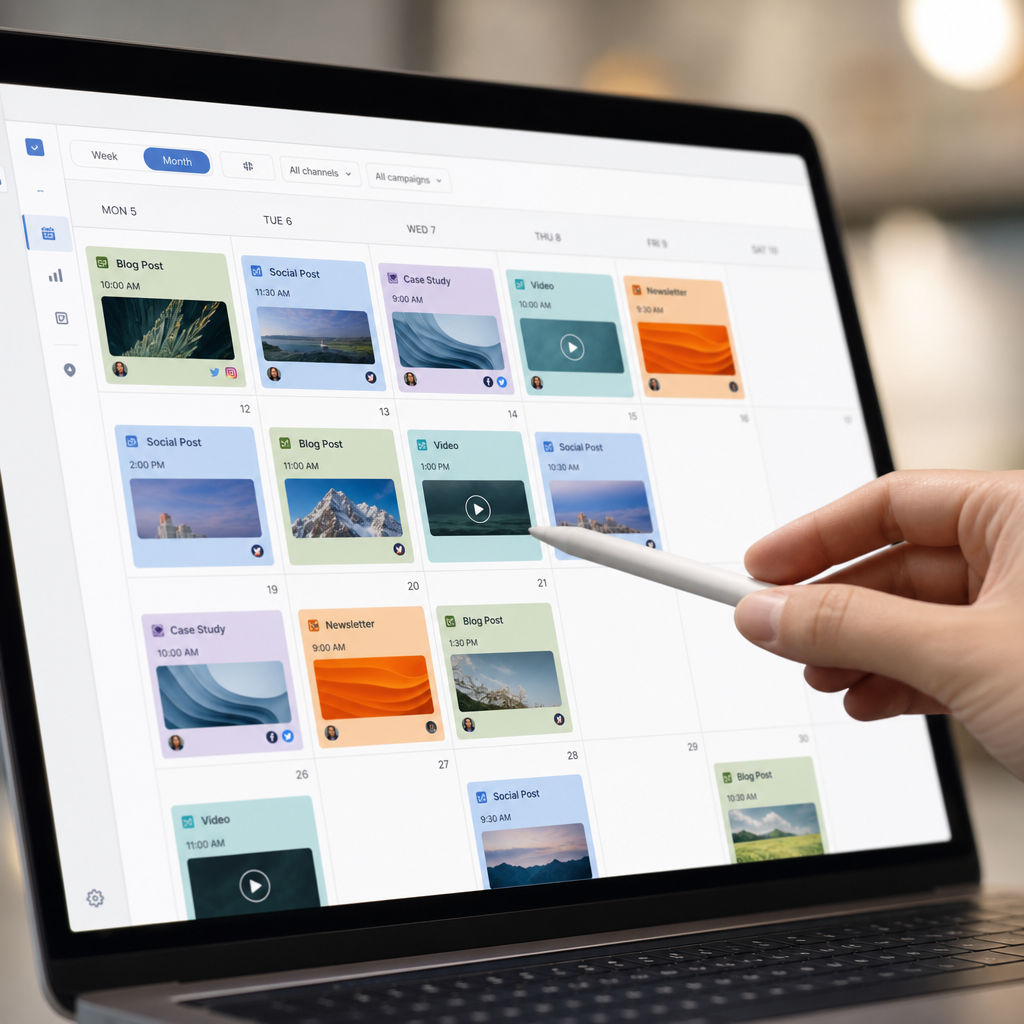
An AI content calendar tool goes beyond a shared spreadsheet with publish dates. It typically combines keyword research, topic clustering, scheduling, and publishing into a single automated workflow. Instead of a marketer manually brainstorming blog ideas every Monday morning, the software analyzes your niche, competitors, and search intent data to generate a rolling calendar of topics designed to build topical authority over time.
Core capabilities usually include:
- Automated keyword discovery — surfacing high-intent, low-competition terms relevant to your industry
- Topic clustering — grouping related keywords into pillar and supporting content structures
- Scheduling logic — determining publish frequency and sequencing based on SEO impact
- Content generation — drafting or fully writing SEO-optimized articles
- AI crawlability auditing — ensuring the site structure allows both Googlebot and AI crawlers (like those powering ChatGPT and Perplexity) to access and cite your content
- Backlink integration — placing contextual internal and external links to build authority signals
Platforms like FrontRank take this further by publishing daily, GEO-optimized (Generative Engine Optimization) articles automatically, with backlinks built in — meaning the calendar isn't just a planning document, it's a production pipeline.
Why Manual Content Calendars Struggle to Keep Up
Manual planning isn't inherently bad — plenty of successful content teams started with a Google Sheet and a content brief template. But manual systems tend to break down at scale for a few predictable reasons:
- Research bottlenecks. Finding new keyword opportunities every week requires tools like Ahrefs or Semrush, plus hours of manual analysis.
- Inconsistent cadence. When the person responsible for updating the calendar goes on vacation or gets pulled into other work, publishing stalls.
- No adaptive intelligence. A static spreadsheet doesn't know that a competitor just outranked you, or that a new AI Overview snippet just changed the SERP landscape.
- Difficult to scale across clients. Agencies managing 10+ client calendars manually often duplicate effort instead of systematizing it.
According to HubSpot's State of Marketing research, consistency in publishing frequency is one of the strongest predictors of organic traffic growth — yet it's also one of the hardest things for lean teams to maintain manually.
Freelance Teams: Flexible, But Expensive and Fragile
Hiring freelance writers and SEO strategists is the traditional middle ground between DIY spreadsheets and full automation. It works, but it introduces its own friction points:
- Onboarding time. Every new freelancer needs brand voice guidelines, SEO training, and topic briefs before they produce usable work.
- Variable quality. Even experienced freelancers vary in how well they optimize for both traditional SEO and newer AI search behavior.
- Turnover risk. Losing a key writer mid-quarter can derail a calendar for weeks.
- Cost scaling linearly. Doubling your content output typically means doubling your freelance spend, which doesn't scale well for startups or agencies working on thin margins.
This doesn't mean human writers add no value — strategic oversight, brand nuance, and subject-matter expertise still matter. But relying entirely on freelance labor to hit a daily or even weekly publishing cadence gets expensive fast, and quality control becomes a full-time job in itself.
Comparing the Three Approaches
| Factor | Manual Calendar | Freelance Team | AI Content Calendar Tool |
|---|---|---|---|
| Setup time | Low | Medium | Low–Medium |
| Ongoing cost | Low (but high time cost) | High, scales with volume | Fixed monthly, scales with plan |
| Publishing consistency | Inconsistent | Depends on management | Daily/automated |
| SEO keyword research | Manual, time-intensive | Varies by freelancer | Automated and continuous |
| AI search (GEO) optimization | Rarely included | Rarely specialized | Built-in |
| Scalability for agencies | Poor | Moderate | High |
| Backlink integration | Manual | Manual | Automated |
This comparison isn't meant to suggest manual planning or freelancers have no place — many teams use a hybrid model. But when the goal is sustained visibility in both Google and AI assistants, automation increasingly wins on consistency and cost-efficiency.
Why AI Search Visibility Changes the Calculus
Traditional SEO content calendars were built around one goal: ranking in Google's ten blue links. That's no longer the whole picture. Tools like ChatGPT, Claude, Gemini, and Perplexity now answer millions of queries daily by synthesizing information from across the web — and they cite sources selectively.
This is where Generative Engine Optimization (GEO) comes in. GEO focuses on making content easy for AI models to parse, extract, and cite — which requires:
- Clear, well-structured headings and answer-first paragraphs
- Schema markup and crawlable site architecture
- Authoritative backlinks and citations
- Fresh, frequently updated content signaling relevance
A Stanford/Princeton study on generative engine optimization found that content structured with clear citations and statistics saw significantly higher visibility in AI-generated answers compared to unstructured prose. This is a fundamentally different optimization target than classic keyword-stuffed SEO copy, and it's why an AI content calendar tool built specifically for GEO — not just traditional SEO — matters so much in 2026.
How FrontRank Approaches Automated Content Calendars
FrontRank was built around the idea that businesses shouldn't need an in-house SEO team or a rotating cast of freelancers to stay visible in both search engines and AI assistants. The platform automates the entire pipeline:
- Site audit — FrontRank first audits your website for AI crawlability issues, checking whether bots from OpenAI, Anthropic, and Google can actually access and understand your pages.
- Keyword and topic generation — the system builds a rolling calendar of relevant, high-intent keywords based on your niche and competitive landscape.
- Daily article production — SEO/GEO-optimized articles are generated and published automatically, each with contextual internal and external backlinks.
- Ongoing optimization — as search trends shift, the calendar adjusts topics and priorities without manual intervention.
This means a founder or agency using frontrank.com doesn't have to manually manage a spreadsheet, brief a freelancer, or guess which keywords matter this month — the calendar builds and executes itself, continuously.
For businesses already managing operational tools like bankstatementboss.com for financial documentation or leadmailbox.com for lead capture and communication, plugging in an automated content engine like FrontRank completes the growth stack — traffic acquisition, lead capture, and back-office operations all running with minimal manual oversight.
Key Features to Look for in an AI Content Calendar Tool
Not all AI content tools are created equal. Many only generate a list of blog topics and leave the writing, publishing, and optimization to you. When evaluating options, look for these capabilities:
- End-to-end automation — from keyword research through publishing, not just idea generation
- AI crawlability auditing — verification that your site is technically accessible to AI models, not just search engine bots
- Built-in backlinking — automated internal and external link placement to build topical authority
- GEO-specific optimization — formatting and structuring content specifically for citation by AI assistants
- Transparent reporting — visibility into what's been published, what's ranking, and what's being cited
- Scalability for multiple sites — critical for agencies managing several client accounts
Comparing Pricing Models
Cost structures vary widely across manual, freelance, and automated approaches. Here's a general breakdown based on typical market rates in 2026:
| Approach | Typical Monthly Cost | Output Volume | Best For |
|---|---|---|---|
| DIY / manual calendar | $0–$200 (tools only) | 2–4 articles/month | Solopreneurs with time to spare |
| Freelance writer(s) | $1,500–$6,000+ | 4–12 articles/month | Businesses needing brand-specific voice |
| SEO agency retainer | $3,000–$10,000+ | 4–8 articles/month | Enterprises with complex strategy needs |
| AI content calendar platform | $200–$1,500 | Daily publishing (20–30+/month) | Startups, eCommerce, agencies scaling output |
The gap in output volume relative to cost is the main reason automated platforms have gained traction so quickly — daily publishing at a fraction of agency retainer pricing is difficult to replicate with human-only teams.
Common Objections — and Why They Don't Hold Up Anymore
Skepticism about AI-generated content is reasonable, especially given the flood of low-quality AI content published in the early 2020s. But the technology and best practices have matured considerably. A few common objections worth addressing:
"AI content ranks poorly." Google has repeatedly clarified through its helpful content guidelines that it doesn't penalize content for being AI-assisted — it penalizes low-quality, unhelpful content regardless of how it's produced. Well-structured, well-researched AI content that satisfies search intent performs comparably to human-written content.
"It won't sound like my brand." Modern platforms allow brand voice customization, tone settings, and review workflows so output aligns with your existing content rather than reading as generic filler.
"AI can't do real keyword strategy." Keyword research is fundamentally a data analysis task — matching search volume, competition, and intent — which is exactly the kind of pattern recognition AI systems excel at, often surfacing opportunities a human strategist would miss simply due to time constraints.

Building a Hybrid Workflow That Works
Even with a fully automated calendar, the strongest content strategies in 2026 combine automation with light human oversight. A practical hybrid workflow looks like this:
- Let the AI tool generate and maintain the base calendar — topics, keywords, and scheduling handled automatically.
- Review flagged high-priority pieces — cornerstone content or product pages that deserve a manual quality pass.
- Monitor performance dashboards weekly — track which articles are earning traffic, backlinks, or AI citations.
- Adjust brand voice settings quarterly — as messaging evolves, update the tool's guidelines rather than rewriting everything manually.
- Use freelancers selectively — for deeply technical or highly specialized topics where subject-matter nuance matters most.
This approach captures the consistency and cost-efficiency of automation while preserving strategic human input where it adds the most value — a balance that neither pure manual planning nor pure freelance staffing can offer on their own.
Measuring Success: What to Track
Whichever approach you choose, tracking the right metrics determines whether your content calendar is actually working. Focus on:
- Organic traffic growth month over month, segmented by new vs. returning pages
- Keyword ranking movement across your target topic clusters
- Backlink acquisition from published content
- AI citation frequency — increasingly trackable through tools monitoring brand mentions in ChatGPT, Perplexity, and Gemini responses
- Conversion rate from organic content to leads or sales
Publishing volume alone isn't a success metric — it's an input. The output that matters is whether your business becomes more visible and more frequently cited across both traditional search and AI-generated answers.
Final Thoughts
Manual calendars offer control but rarely scale. Freelance teams offer nuance but come with cost and consistency tradeoffs. An AI content calendar tool offers the one thing both alternatives struggle to deliver at scale: relentless, data-driven consistency across both SEO and the newer discipline of generative engine optimization.
For founders, marketers, eCommerce owners, and agencies trying to compete for visibility in Google and AI assistants simultaneously, automation isn't a shortcut — it's becoming the baseline expectation. FrontRank was built specifically for this shift, combining AI-driven keyword research, crawlability audits, and daily publishing into one system so businesses can build durable search and AI visibility without hiring a full content team. If consistent, cited, and ranked content is the goal, frontrank.com offers a practical way to get there without the overhead of manual planning or the cost of scaling a freelance roster.
Article written by FrontRank