
Most small business owners already know they need a blog. Google rewards sites that publish fresh, relevant content, and AI assistants like ChatGPT and Perplexity increasingly cite sources that demonstrate topical depth. The problem has never been knowing you need a blog — it's finding the time, budget, and talent to actually produce one, week after week, without it becoming another neglected to-do list item.
This is where an AI content pipeline for small business changes the equation. Instead of hiring writers, managing freelancers, or paying an agency retainer, a content pipeline automates the entire process — from topic research to publishing — and runs quietly in the background while you run your business. Below, we break down what a real content pipeline looks like, how it compares to traditional options, and what to look for before you commit to one.
1. What an AI Content Pipeline Actually Is
An AI content pipeline is not just "AI writing software." A writing tool gives you a document full of text that you still have to edit, format, add images to, and manually upload to your website. A pipeline, by contrast, is an end-to-end system that handles every stage of blog production:
- Topic and keyword research — identifying what your customers are actually searching for
- Content calendar planning — scheduling topics in a logical, non-repetitive sequence
- Drafting — writing full-length, structured articles
- On-page SEO formatting — headers, meta descriptions, internal links, readability
- Publishing — pushing the finished post live on your CMS automatically
The distinction matters because most of the labor in content marketing isn't the writing itself — it's the coordination around it. Deciding what to write about, keeping a calendar consistent, formatting for SEO, and remembering to hit "publish" every week are the tasks that cause blogs to quietly die after three posts. A proper pipeline, like the one FrontRank runs for small businesses and agencies, removes every one of those friction points by connecting directly to your CMS — WordPress, Webflow, Wix, Shopify, Ghost, or Framer — and publishing on a daily schedule without any copy-pasting or API setup.
2. Why Small Businesses Struggle to Blog Consistently
Search behavior has shifted dramatically. According to Google's own documentation on helpful content, sites that publish content consistently and demonstrate subject-matter depth are more likely to earn sustained rankings — a one-off blog post rarely moves the needle. Yet most small businesses stop blogging almost as soon as they start. The reasons are consistent across industries:
- No dedicated marketing staff. A solo founder or small team is already stretched across sales, operations, and customer service.
- Writing is a specialized skill. Even great operators often aren't confident writers, and generic AI chatbot output reads exactly like what it is — generic.
- SEO strategy is unclear. Most owners don't know which keywords their customers search, let alone how to structure a post to rank for them.
- No time to manage a calendar. Planning twelve months of topics in a spreadsheet is a project nobody has a free weekend for.
- Agencies are expensive. A single well-researched SEO article from a freelancer or agency commonly costs $100 to $500 per post, and that's before strategy or management fees.
The result is a graveyard of blogs with three posts from 2022 and nothing since. An automated pipeline solves this not by making writing easier, but by removing the human bottleneck altogether.
3. AI Content Pipeline vs. Freelancers vs. In-House Writers vs. Agencies
Choosing how to produce content is really a trade-off between cost, consistency, and control. Here's how the major options stack up for a small business or agency managing multiple client sites.
| Option | Monthly Cost (approx.) | Consistency | SEO Strategy Included | Publishing Effort |
|---|---|---|---|---|
| In-house writer | $3,000–$6,000+ salary | High, if retained | Rarely, needs separate SEO hire | Manual |
| Freelance writer | $800–$2,500 for 4–8 posts | Variable, depends on availability | Usually not included | Manual upload |
| SEO/content agency | $1,500–$5,000+ retainer | Moderate to high | Yes, often slow turnaround | Manual or managed |
| AI content pipeline (e.g. FrontRank) | Flat low monthly fee | Daily, automated | Built-in keyword & calendar research | Fully automatic |
The pattern is clear: every traditional option requires ongoing human coordination, and that coordination is exactly where consistency breaks down. A pipeline is the only option on this list designed specifically to never miss a publishing date, because there's no calendar invite to forget or invoice to delay.
4. The Core Stages of a Working Content Pipeline
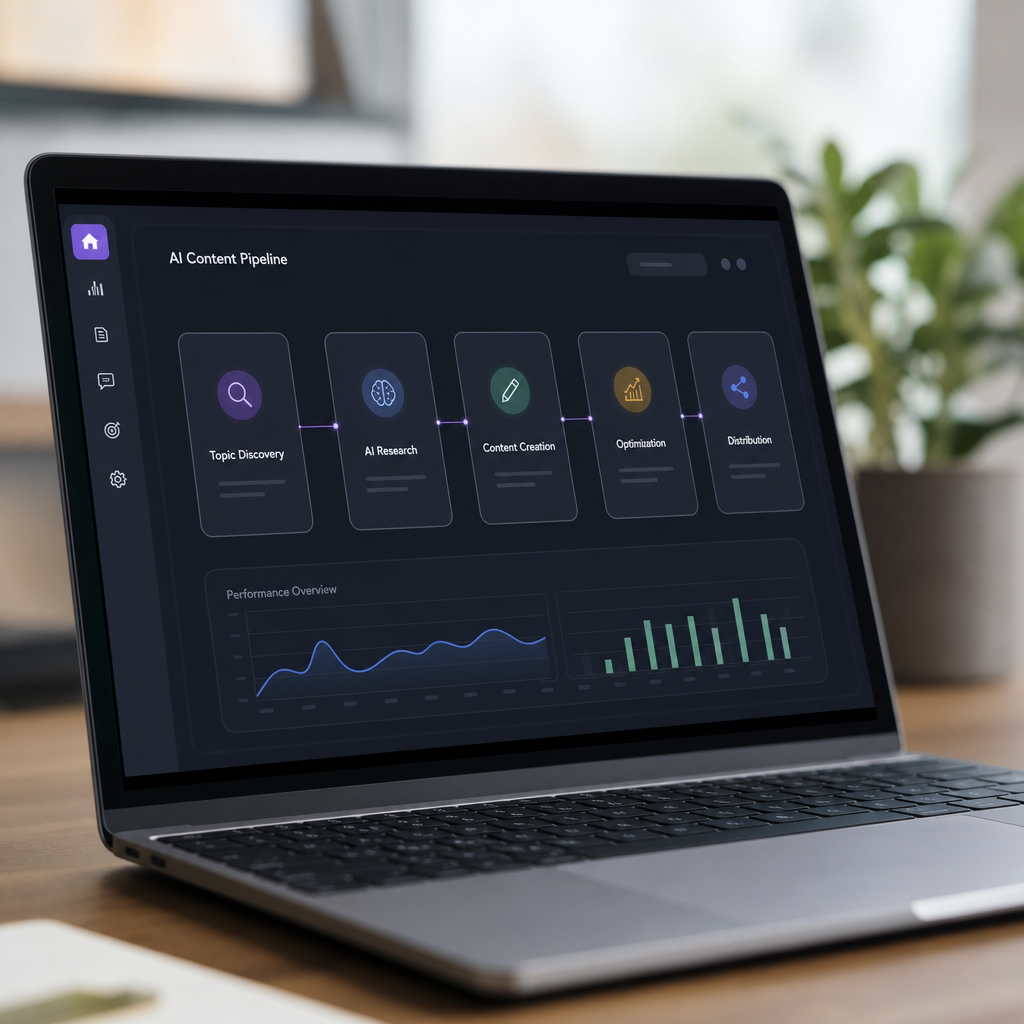
A genuinely useful AI content pipeline for small business isn't a single feature — it's a sequence of automated decisions. Understanding each stage helps you evaluate whether a tool is a real pipeline or just a fancy text generator.
Keyword and Topic Discovery
The pipeline should identify keywords relevant to your specific business and location, not generic industry terms. This typically draws on competitor gaps, search volume data, and commercial intent signals, similar to the research approach outlined by Moz's guide to keyword research.
Content Calendar Construction
Rather than publishing random, disconnected posts, a good pipeline clusters related topics together to build topical authority — a concept search engines increasingly weight when deciding which sites to trust for a subject.
Drafting and Structuring
The article is written in full, with proper H2/H3 structure, internal linking logic, and readability formatting — not a wall of unformatted text.
On-Page SEO Optimization
Meta titles, meta descriptions, slug formatting, and image alt text are generated alongside the article, not left for you to add later.
Direct CMS Publishing
The finished post is pushed live automatically to your actual website — FrontRank connects to WordPress, Webflow, Wix, Shopify, Ghost, and Framer in a single click, with no API keys or developer setup required.
5. What to Look For in an AI Content Pipeline
Not every "AI blog tool" delivers a full pipeline. Many only solve one piece of the puzzle and leave you to handle the rest manually. Before choosing a tool, check for these capabilities:
- Direct CMS integration — Does it publish automatically, or does it just hand you a Google Doc?
- No API key setup — Can a non-technical owner connect their site in minutes, or does it require a developer?
- Keyword research built in — Does it find relevant topics on its own, or do you need to supply them?
- Calendar automation — Does it plan months ahead, or only generate one post at a time?
- Multi-site support — If you're an agency, can you manage several client blogs from one dashboard?
- Human-quality writing — Does the output read naturally, with structure and specificity, or is it generic filler?
- E-E-A-T awareness — Does it reflect Google's emphasis on experience, expertise, authority, and trust rather than keyword-stuffed text?
A tool that checks all of these boxes is functioning as a true pipeline rather than a writing assistant. This distinction is particularly important for agencies, where managing five or ten client blogs manually multiplies every inefficiency by the number of accounts.
6. Comparing Manual Workflows to an Automated Pipeline
To understand the real time savings, it helps to look at the actual hours involved in producing a single SEO blog post the traditional way versus through automation.
| Task | Manual Workflow (Hours) | Automated Pipeline |
|---|---|---|
| Keyword research | 1–2 hours | Automatic |
| Topic planning | 0.5–1 hour | Automatic |
| Writing draft | 2–4 hours | Automatic |
| Editing & formatting | 1 hour | Automatic |
| SEO metadata (title, meta, slug) | 0.5 hour | Automatic |
| Uploading to CMS | 0.5 hour | Automatic |
| Total per post | 5.5–9 hours | ~0 hours of owner time |
Multiply that by 52 weeks, and a business publishing weekly is looking at 300–450 hours a year just to maintain a basic blog — before accounting for strategy, revisions, or inconsistent output quality. For agencies managing ten client sites, that number becomes unmanageable without a large content team. This is precisely the workload an AI content pipeline for small business is designed to absorb, letting a business publish daily instead of occasionally, without adding headcount.
7. Getting Started Without Disrupting Your Existing Site
A common concern among small business owners is that automating content means losing control over brand voice or risking low-quality output appearing on a site they've spent years building. A well-designed pipeline addresses this in a few specific ways:
- One-click CMS connection — no manual exporting or pasting, which also means no risk of broken formatting.
- Review options before publishing — many pipelines allow approval workflows for businesses that want a final check.
- Consistent brand tone — the system should be configured around your industry and audience, not generic templates.
- Gradual scaling — most businesses start with a few posts per week and increase frequency once they see results.
- No lock-in to writing contracts — because there's no freelancer relationship to manage, pausing or adjusting frequency is simple.
For eCommerce stores in particular, this matters because product pages alone rarely rank for informational search queries. A blog is what captures the research-stage searches — "best [product] for [use case]," "how to choose [category]," comparison posts — that eventually convert into product page visits. Without that content layer, a store is invisible for the exact queries that build long-term organic traffic. Shopify's own research on content marketing confirms that stores publishing regular educational content see meaningfully higher organic traffic over time compared to product-only sites.

8. Why This Matters for AI Search, Not Just Google
As of 2026, search behavior has split in two directions: traditional Google queries and AI assistant queries through tools like ChatGPT, Perplexity, and Google's AI Overviews. Both reward the same underlying signal — depth and consistency of content on a given topic — but AI assistants in particular tend to cite sources that have published comprehensively around a subject area rather than a single standout page. This is sometimes referred to as Generative Engine Optimization, or GEO, and it's a natural extension of the topical authority principles SEOs have followed for years.
A business with three blog posts has almost no chance of being cited by an AI assistant answering a question in its niche. A business with 150 well-structured, keyword-targeted posts covering every angle of its industry has a real shot — not because the content is manipulative, but because it genuinely covers the subject in the depth these systems are designed to reward. This is the long-term value of an AI content pipeline for small business: it's not a shortcut to rank for one keyword, it's infrastructure that compounds in value every month it keeps running.
Final Thoughts
Blogging consistently has always been simple in concept and difficult in practice. The businesses that succeed at content marketing aren't necessarily the ones with the best writers — they're the ones that never stop publishing. An AI content pipeline for small business makes that consistency achievable without hiring staff, managing freelancers, or paying agency retainers that stretch your marketing budget thin.
FrontRank was built specifically for this gap: it researches keywords, builds the content calendar, writes the articles, and publishes them directly to your CMS automatically, every single day, with no API keys, no copy-pasting, and no writing required from you. Whether you're a solo store owner who's never had time to blog, or an agency managing content across a dozen client sites, frontrank.com turns "we should really start a blog" into a working, ranking blog that runs itself.
Article written by FrontRank