
Most small business owners don't need another writing tool that spits out a draft into a text box. They need something that actually gets content onto their site — written, formatted, and live — without someone copying and pasting it into WordPress at 11pm. That's the real meaning behind the search for an "AI writer that connects to my website": not just AI-generated text, but AI that publishes.
As of 2026, dozens of AI writing tools exist, but very few actually integrate with a CMS and handle the full path from idea to published page. This article breaks down what that kind of tool should do, how it differs from a generic AI writer, and what to look for before you commit your blog to one.
1. It Should Actually Connect to Your CMS, Not Just Export Text
A lot of "AI writer" products are really just AI document editors. You type a prompt, you get a draft, and then it's on you to format it, add images, pick a category, and publish it manually. That's not connection — that's generation with extra steps.
A genuine AI writer that connects to your website should:
- Authenticate directly with your CMS (WordPress, Webflow, Wix, Shopify, Ghost, or Framer)
- Push formatted posts — headings, links, images, meta fields — directly into your site's publishing queue
- Respect your site's existing theme, categories, and tagging structure
- Let you review or auto-publish, depending on how hands-off you want to be
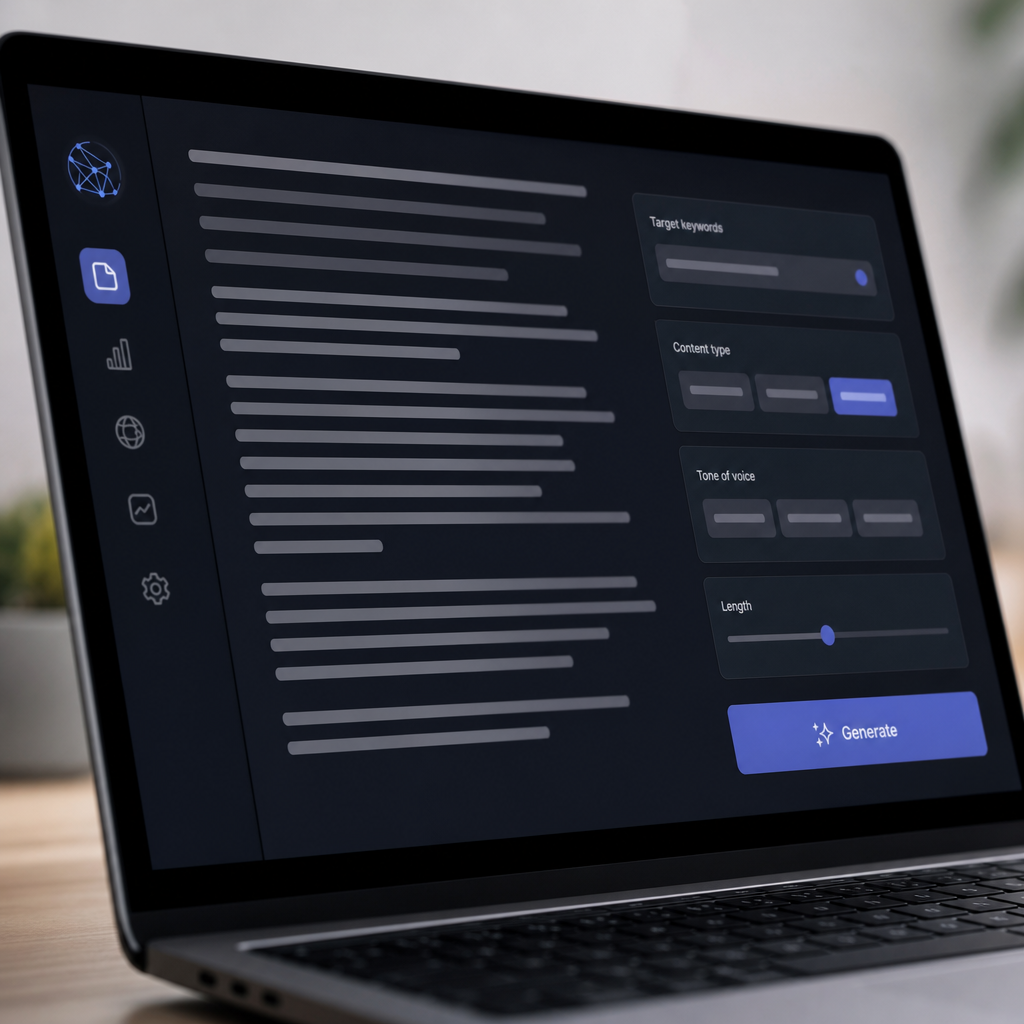
This is the core difference between a writing assistant and a publishing system. FrontRank was built specifically around this gap: you connect your CMS in one click, with no API keys and no manual exporting, and articles go live on a schedule without anyone touching the backend.
2. It Needs a Real Content Strategy, Not Just a Prompt Box
Publishing access solves half the problem. The other half is knowing what to publish. An AI writer that only responds to whatever prompt you type will run out of good ideas within a few weeks, and most small business owners don't have a running list of 200 blog topics sitting in a spreadsheet.
A strong system should handle strategy automatically by:
- Researching your niche and competitors to find realistic keyword opportunities
- Building a content calendar that spreads topics across buyer intent — awareness, comparison, and decision-stage searches
- Avoiding keyword cannibalization between posts
- Adjusting the calendar over time based on what's actually ranking
This is where tools differ the most. Some ask you to supply keywords manually. Others — like FrontRank — generate the keyword research and calendar themselves, so the business owner never has to think about topic selection at all. According to Google's own guidance on helpful content, consistency and topical relevance matter more than any single post, which is exactly why a calendar-driven approach outperforms one-off AI drafts.
3. It Should Write for Both Google Rankings and AI Answer Engines
Search behavior has changed. People still type into Google, but they also ask ChatGPT, Perplexity, and Google's AI Overviews for recommendations, and those systems pull from content that's structured clearly and backed by real expertise signals. This is often called GEO — generative engine optimization — and it's quickly becoming as important as traditional SEO.
An AI writer built for 2026 should optimize for both at once:
| Optimization Target | What It Requires |
|---|---|
| Traditional Google SEO | Keyword targeting, internal linking, meta tags, page speed, E-E-A-T signals |
| AI Assistant Citations (GEO) | Clear structure, direct answers, factual accuracy, source-worthy phrasing |
| User Experience | Readability, scannable formatting, mobile-friendly layout |
Tools that only chase keyword density were built for 2015-era SEO. The Search Engine Journal overview of E-E-A-T explains why experience and trust signals now matter more than keyword stuffing — and that applies just as much to how AI assistants decide what to cite as it does to Google rankings.
4. It Should Handle Multiple Sites Without Multiplying the Work
Digital agencies and multi-location business owners face a specific version of this problem: it's not one blog, it's five, ten, or twenty. Hiring a writer for each client site is expensive, and managing freelancers across accounts is its own full-time job.
A capable AI writer that connects to websites at scale should let an agency:
- Connect multiple client CMS accounts from a single dashboard
- Run independent content calendars per client, each targeting that client's specific keywords
- Maintain brand voice consistency per site without manual style guides
- Report on publishing activity and rankings across all accounts in one place
This is a very different workload than writing a single blog post. Agencies managing multiple client sites need a system, not a tool, and FrontRank is built around exactly that kind of multi-site operation — connect each client's CMS once, and every site gets its own calendar and keyword strategy running independently in the background.
5. It Should Replace, Not Just Assist, the Manual Workflow
It's worth being honest about what most small businesses are actually choosing between. It isn't "AI tool vs. perfect human writer." It's "AI tool vs. nothing," because the realistic alternative to automation is usually an empty blog that hasn't been updated in eight months.
Here's how the common paths compare:
| Approach | Monthly Cost (approx.) | Time Required | Publishing Consistency |
|---|---|---|---|
| Freelance writer + manual publishing | $400–$1,500 | 3–6 hours/week managing | Inconsistent, depends on availability |
| SEO agency retainer | $1,000–$5,000+ | 1–2 hours/week in meetings | Usually consistent, slow to start |
| Generic AI writing tool (copy-paste) | $20–$100 | 2–4 hours/week editing & publishing | Depends entirely on the user |
| AI writer connected to CMS (e.g. FrontRank) | Flat monthly fee | Minutes to set up, near-zero ongoing | Fully automatic, daily or weekly |
The appeal of a connected AI writer isn't just cost — it's that the publishing step, which is where most blogs quietly die, is removed from the equation entirely. Research from HubSpot on blogging frequency consistently shows that businesses publishing weekly or more see significantly higher traffic growth than those publishing sporadically, and sporadic publishing is almost always a function of friction, not ideas.
6. It Should Be Safe, Reviewable, and On-Brand
Automation only works if a business owner can trust what's going out under their name. Before connecting any AI writer to a live website, it's reasonable to expect certain guardrails:
- Preview or approval mode — the option to review drafts before they go live, at least initially
- Brand voice settings — so articles sound like the business, not like a generic template
- Fact-checking discipline — especially for YMYL-adjacent topics like health, finance, or legal services, where Google's quality rater guidelines place extra weight on accuracy and trustworthiness
- No duplicate or thin content — each article should be a genuinely useful page, not a reworded template
A well-built system lets you start in review mode and move to full autopilot once you trust the output. That gradual handoff matters more than it sounds — it's the difference between cautiously testing automation and gambling your site's reputation on it.

7. It Should Fit Into How You Already Work, Not Add a New Tool to Manage
The irony of a lot of AI SEO software is that it was supposed to save time but instead becomes one more dashboard to check, one more login to remember, one more thing that needs "managing." If an AI writer that connects to your website still requires you to:
- Manually approve every keyword
- Format articles before publishing
- Upload images separately
- Write your own meta descriptions
- Check a separate analytics tool to see if it's even working
...then it hasn't actually removed the workload, it's just relocated it. The goal of true CMS-connected automation is that the tool disappears into the background. You connect it once, it builds the calendar, writes the posts, picks the keywords, and publishes on schedule — and your only ongoing task is occasionally checking that your blog is growing, the same way you'd glance at a sales dashboard.
This is the standard FrontRank was built to meet: one-click CMS connection, no API keys, no copy-paste, and no writing required from the business owner at any stage. The system builds the calendar, generates the keywords, writes the articles, and publishes them automatically across WordPress, Webflow, Wix, Shopify, Ghost, or Framer — so a business ends up with a genuinely working blog instead of a project that stalled after three posts.
What to Ask Before You Connect Any AI Writer to Your Site
Before signing up for any tool that claims to connect to your website, it's worth asking a short list of direct questions:
- Does it publish directly into my CMS, or just generate text I still have to move myself?
- Does it build its own content calendar and keyword list, or do I need to supply topics?
- Does it optimize for AI assistants and answer engines, not just Google's classic algorithm?
- Can I manage multiple client sites from one account, if I run an agency?
- Can I review content before it publishes, and adjust brand voice over time?
- What happens to my existing posts and SEO history if I ever want to switch tools?
If a tool can't answer most of these clearly, it's probably a writing assistant wearing an "AI SEO" label — useful for drafting, but not for actually running a blog on autopilot.
Bringing It All Together
The phrase "AI writer that connects to my website" describes a very specific need: not help writing, but help publishing — consistently, correctly, and without becoming a second job. The businesses that benefit most are the ones that already know they need a blog, already have a CMS in place, and simply don't have the time, team, or desire to write and manage content themselves.
A tool that checks all seven boxes above — real CMS integration, automated strategy, dual optimization for Google and AI assistants, multi-site support, workflow replacement, brand safety, and true hands-off operation — is solving a fundamentally different problem than a chatbot that writes paragraphs on request.
FrontRank was built around that exact distinction: connect your CMS in one click, and get a working blog that builds its own calendar, writes its own articles, and publishes them automatically, so your site can start ranking in Google and getting cited by AI assistants without hiring a writer or paying for an agency retainer.
Article written by FrontRank