
Ecommerce brands live and die by discoverability. If shoppers can't find your product pages in Google, and increasingly, if AI assistants like ChatGPT, Claude, and Gemini never mention your brand when answering shopping questions, you lose sales to competitors who invested in visibility. Yet most ecommerce teams are stretched thin, juggling inventory, ads, fulfillment, and customer service. SEO often becomes the task that gets pushed to "next quarter" indefinitely.
That's where automation changes the equation. Automating SEO for ecommerce means using software and AI to handle the repetitive, time-intensive parts of search optimization — keyword research, content creation, technical audits, and publishing — so your team can focus on strategy and growth instead of manual busywork.
This guide breaks down exactly what ecommerce SEO automation looks like in practice, why it matters more than ever in the age of AI search, and how platforms like FrontRank are helping stores and agencies scale organic visibility without hiring a full content team.
Why Ecommerce SEO Is Different — and Harder to Scale
Ecommerce SEO isn't like optimizing a single landing page or a small blog. Online stores often have hundreds or thousands of product pages, category pages, filters, and variants — all of which need unique, optimized content to rank well and avoid duplicate content penalties.
A few factors make ecommerce SEO uniquely challenging:
- Scale: A store with 2,000 SKUs needs thousands of optimized titles, descriptions, and metadata — far more than a typical content site.
- Constant change: Products get added, discontinued, restocked, or repriced regularly, which means SEO content needs continuous updates.
- Competitive keywords: Commercial, high-intent keywords are dominated by big-budget retailers like Amazon and Walmart.
- Technical complexity: Faceted navigation, pagination, and JavaScript-heavy themes (common in Shopify and headless builds) can create crawlability issues.
- AI search disruption: Shoppers now ask ChatGPT or Gemini for product recommendations directly, bypassing traditional search results entirely.
Manually managing all of this — writing unique copy for every category, auditing technical health, tracking keyword rankings, and building backlinks — is simply not sustainable without automation, especially for lean teams.
What Does It Mean to Automate SEO for Ecommerce?
Automating SEO doesn't mean replacing strategy with a "set it and forget it" script. It means using AI and workflow automation to handle the labor-intensive, repeatable parts of SEO, while still keeping oversight on brand voice and business goals. In practice, this includes:
- Automated keyword research — AI tools continuously scan search trends, competitor rankings, and buyer intent signals to surface new keyword opportunities.
- AI-generated content calendars — Instead of manually planning blog topics each month, software builds a rolling calendar based on keyword gaps and seasonal demand.
- Automated content creation — AI drafts SEO-optimized articles, buying guides, and category descriptions at scale, matched to your brand tone.
- Technical SEO audits — Automated crawlers check site speed, indexability, structured data, and now AI crawlability (whether bots like GPTBot or Claude's crawler can read your pages).
- Publishing and internal linking — Approved content gets published directly to your site or CMS, often with backlinks and internal links added automatically.
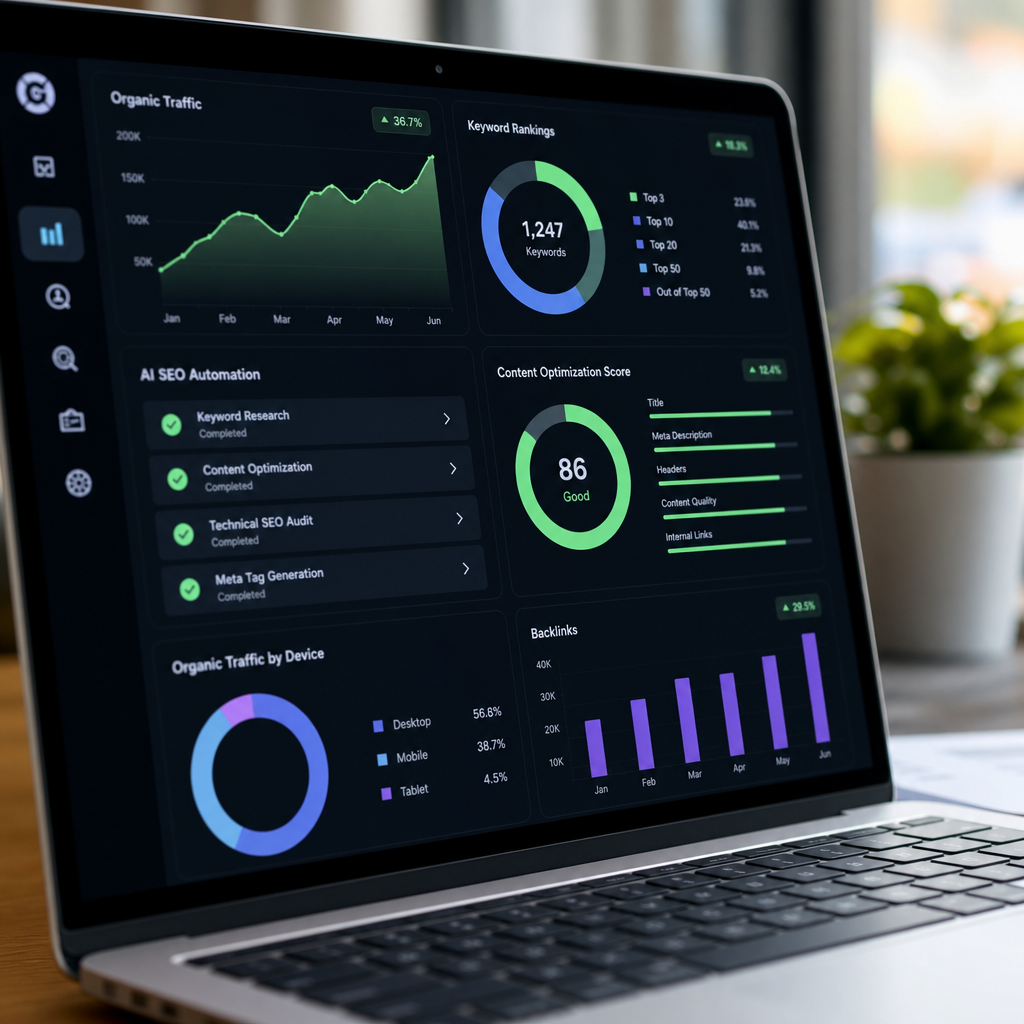
- Performance tracking — Dashboards report on rankings, organic traffic, and citations in AI-generated answers.
This is precisely the workflow that platforms like FrontRank are built around — automating not just traditional SEO but Generative Engine Optimization (GEO), the practice of optimizing content so AI assistants cite your brand as a trusted source.
Traditional SEO vs. Automated SEO for Ecommerce
To understand the value of automation, it helps to compare how ecommerce teams typically handle SEO manually versus how automated systems handle the same tasks.
| Task | Manual Approach | Automated Approach |
|---|---|---|
| Keyword research | Analyst spends hours in tools like Ahrefs or Semrush monthly | AI continuously scans search data and updates keyword lists daily |
| Content creation | Freelance writers or in-house team, 2-5 articles/week | AI generates and publishes optimized articles daily |
| Technical audits | Quarterly audits by an SEO consultant | Continuous automated crawls flagging issues in real time |
| AI crawlability checks | Rarely performed; new discipline | Built-in audits for GPTBot, ClaudeBot, and other AI crawlers |
| Backlink building | Manual outreach, slow and expensive | Automated backlink placement through content networks |
| Reporting | Manual spreadsheet updates | Real-time dashboards with ranking and citation tracking |
The difference isn't just speed — it's consistency. Google and AI models both reward sites that publish fresh, relevant content on a predictable schedule. Manual processes struggle to keep that cadence; automation makes it the default.
The Rise of AI Search and Why GEO Matters for Ecommerce
Search behavior is shifting fast. According to Gartner, traditional search engine volume is projected to drop significantly as consumers turn to AI assistants for recommendations and research. For ecommerce brands, this means optimizing only for Google's blue links is no longer enough.
When a shopper asks ChatGPT "what's the best organic skincare brand for sensitive skin," the AI doesn't scroll through ten search results — it pulls from indexed content it deems authoritative and directly cites a handful of sources. If your ecommerce brand's product pages and content aren't structured in a way that AI models can parse and trust, you simply won't be part of that answer.
This is the core idea behind GEO (Generative Engine Optimization) — optimizing content specifically so it gets referenced by AI systems, not just ranked by search algorithms. Key GEO practices include:
- Writing clear, factual, well-structured answers to common questions
- Using schema markup so AI crawlers can easily parse product and article data
- Ensuring technical crawlability for AI bots (many sites accidentally block them via robots.txt)
- Publishing consistently so AI training and retrieval systems see your site as active and authoritative
- Earning backlinks from other reputable sites, which signals trust to both search engines and AI models
FrontRank was built specifically around this shift — auditing sites for AI crawlability, then automatically publishing daily GEO-optimized articles with backlinks designed to get ecommerce brands cited by AI assistants as well as ranked in traditional search.
Core Components of an Automated Ecommerce SEO System
If you're evaluating tools or building an automated SEO workflow for your store, here are the essential building blocks to look for.
1. AI Content Calendars
A good automation platform doesn't just generate random blog posts — it builds a structured calendar based on your niche, competitors, and seasonal shopping trends (think holiday gift guides in Q4, back-to-school content in August, etc.). This ensures content is strategically timed rather than random.
2. Keyword and Topic Generation
Automated keyword research should go beyond volume and difficulty scores. The best systems analyze buyer intent — distinguishing between someone researching "best running shoes for flat feet" (informational) versus "buy Nike Pegasus 41" (transactional) — and generate content calendars that cover the full funnel.
3. AI Crawlability Audits
This is a newer but increasingly critical category. Many ecommerce sites unknowingly block AI crawlers, use JavaScript rendering that AI bots can't process, or lack the structured data needed for models to extract accurate product information. An automated audit should check:
- Robots.txt rules for AI-specific crawlers (GPTBot, ClaudeBot, Google-Extended)
- Server-side rendering vs. client-side rendering issues
- Schema.org structured data for products, reviews, and FAQs
- Page load speed and Core Web Vitals, per Google's guidelines
4. Automated Publishing with Backlinks
Once content is generated and reviewed, it needs to be published consistently — ideally with internal links to relevant product/category pages and backlinks from other authoritative sites. Backlinks remain one of the strongest ranking signals, as confirmed repeatedly in Google's Search Central documentation.
5. Performance Monitoring
Automation isn't useful without visibility. Dashboards should track organic traffic growth, keyword rankings, and — increasingly — how often your brand is cited in AI-generated answers, a metric traditional SEO tools weren't built to measure.
Step-by-Step: How to Automate SEO for Your Ecommerce Store
Here's a practical roadmap for implementing SEO automation, whether you're a solo founder or managing SEO for multiple client stores at an agency.
- Audit your current SEO and AI crawlability. Before automating anything, understand where you stand. Run a technical audit covering indexability, site speed, and whether AI crawlers can access your content.
- Identify content gaps. Use automated keyword tools to find topics competitors rank for that you don't — buying guides, comparison pages, "best of" lists, and FAQ content.
- Set a publishing cadence. Consistency matters more than volume. Publishing one well-optimized article daily consistently outperforms sporadic bursts of ten articles once a month.
- Automate content generation with human oversight. Use AI to draft content, but maintain a light review process to ensure brand voice, accuracy, and compliance — especially for regulated categories like health or finance products.
- Build internal linking automatically. Every new article should link back to relevant product or category pages to pass authority and guide shoppers toward purchase.
- Earn backlinks through content partnerships. Quality backlinks from relevant publishers or partner networks continue to strengthen domain authority. For example, some brands build visibility through partner news placements like www.everysun.com, which can help diversify a backlink profile beyond owned content.
- Track rankings and AI citations monthly. Adjust your content calendar based on what's actually driving traffic and AI visibility, not just what sounded like a good idea.
This is essentially the workflow FrontRank automates end-to-end — from the audit in step one through the publishing and tracking in steps six and seven — condensing what would normally take a team of specialists into a single ongoing subscription.
Common Mistakes Ecommerce Brands Make When Automating SEO
Automation is powerful, but poorly implemented automation can backfire. Watch out for these common pitfalls:
| Mistake | Why It Hurts | Better Approach |
|---|---|---|
| Publishing AI content with no review | Risk of factual errors or generic content that fails to rank | Use a lightweight human review step before publishing |
| Ignoring technical SEO | Even great content won't rank on a slow, uncrawlable site | Pair content automation with ongoing technical audits |
| Keyword stuffing product pages | Search engines penalize unnatural repetition | Focus on natural language and search intent |
| Duplicate content across product variants | Confuses search engines about which page to rank | Use canonical tags and unique descriptions per variant |
| Neglecting AI crawlability | Missed opportunities to be cited by ChatGPT, Gemini, etc. | Regularly audit robots.txt and structured data |
| No consistent publishing schedule | Search engines and AI systems favor freshness and consistency | Automate a daily or weekly publishing cadence |
Avoiding these mistakes is often less about having more resources and more about having the right automated checks in place from day one.

Measuring ROI: What Success Looks Like
Automating SEO should produce measurable outcomes, not just "more content." When evaluating whether your automation strategy is working, track these metrics:
- Organic traffic growth month-over-month, segmented by landing page type (blog vs. product vs. category)
- Keyword ranking improvements, especially for commercial and long-tail informational terms
- AI citation frequency — how often your brand appears in answers from ChatGPT, Claude, Gemini, or Perplexity when relevant questions are asked
- Conversion rate from organic and AI-referred traffic, since visibility only matters if it drives sales
- Backlink growth, both in quantity and domain authority of linking sites
- Time saved by your team compared to manual content and SEO management
Most ecommerce brands using automated SEO systems report meaningful organic traffic growth within three to six months, provided the underlying site has no major technical blockers. The compounding nature of consistent publishing means results tend to accelerate over time rather than plateau, particularly as backlinks and topical authority build up.
Why Choose a Purpose-Built Platform Over Piecing Together Tools
Many ecommerce teams try to DIY automation by stitching together a keyword tool, an AI writing assistant, a scheduling plugin, and a rank tracker. This can work, but it creates fragmented workflows, inconsistent quality control, and no unified view of performance across traditional and AI search.
A dedicated platform like FrontRank consolidates the entire pipeline — content calendar generation, keyword research, AI-optimized writing, technical and AI-crawlability audits, publishing, and backlink placement — into a single system built specifically for the dual goals of ranking in Google and getting cited by AI assistants. For founders and agencies managing multiple stores, this consolidation isn't just convenient; it's the difference between SEO actually happening consistently versus becoming another neglected to-do list item.
Final Thoughts
SEO for ecommerce has always been demanding, but the emergence of AI-driven search has raised the stakes further. Brands that automate their content strategy, technical audits, and AI crawlability now will be the ones showing up in both Google search results and AI-generated shopping recommendations over the next several years. Waiting to "get to SEO eventually" means ceding that visibility to competitors who automated first.
FrontRank exists to make that automation accessible without requiring an in-house team of writers and SEO specialists. By publishing daily, GEO-optimized articles with backlinks, auditing sites for AI crawlability, and building data-driven content calendars automatically, frontrank.com helps ecommerce founders, marketers, and agencies grow organic traffic and AI search visibility on autopilot — so you can spend less time managing SEO and more time growing your business.
Article written by FrontRank