
Most business owners don't fail at blogging because they lack ideas. They fail because nobody has time to plan a calendar, research keywords, write the post, format it, and publish it — week after week, month after month. That's the exact gap an automatic content calendar and publishing tool is built to close, and it's why this category of software has become one of the fastest-growing corners of AI SEO automation in 2026.
This article breaks down what these tools actually do, how they differ from traditional content planning methods, and how to evaluate one before you commit your blog — and your brand's search visibility — to it.
What Is an Automatic Content Calendar and Publishing Tool?
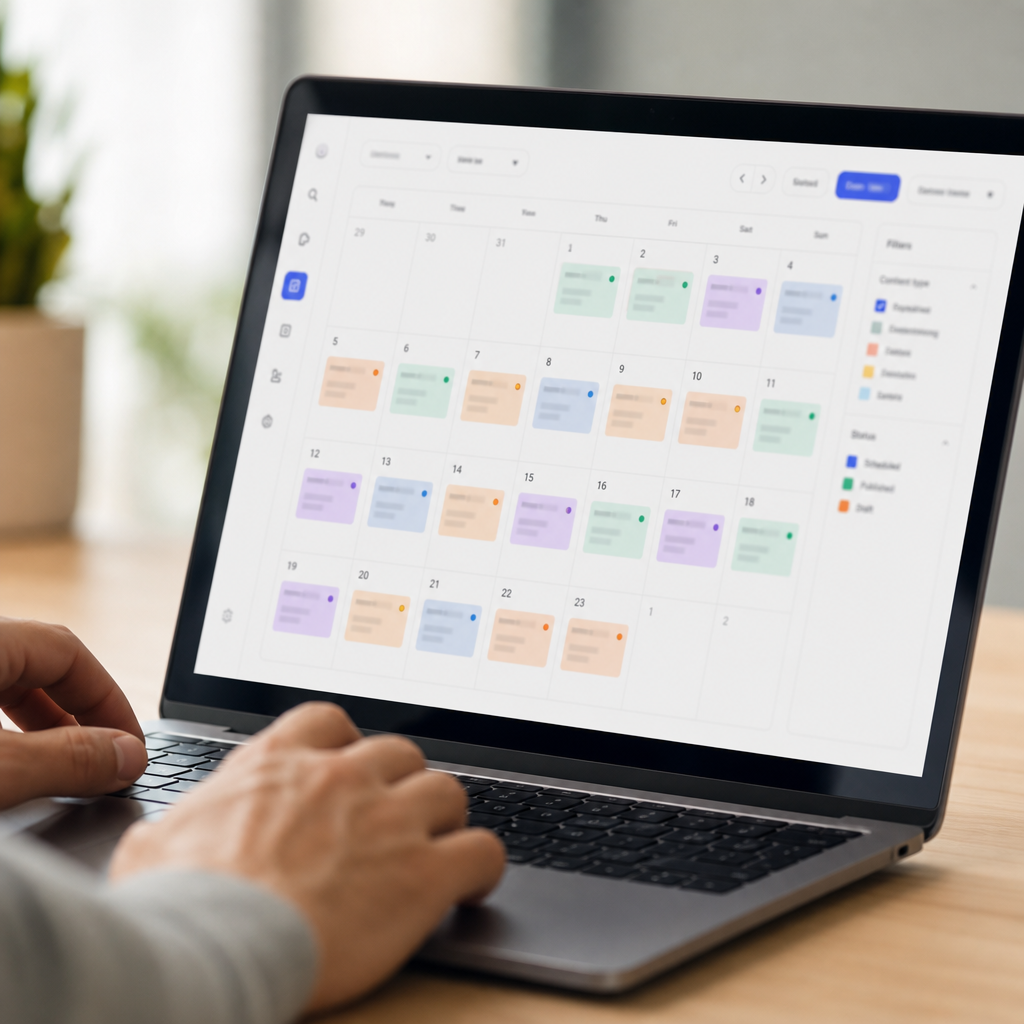
An automatic content calendar and publishing tool is software that plans, writes, and publishes blog content on a schedule without requiring a human to manage each step. Instead of a marketer building a spreadsheet of topics, briefing a writer, editing drafts, and manually uploading posts to a CMS, the entire pipeline runs on its own.
At a basic level, these tools typically handle:
- Keyword research — identifying topics your audience is actually searching for
- Calendar generation — scheduling what gets published and when, often daily or weekly
- Article writing — producing full-length, structured blog posts
- Direct publishing — pushing the finished article into your CMS automatically
The category sits at the intersection of two trends that have been building for years: content marketing's proven effect on organic traffic, and generative AI's ability to produce publish-ready writing. HubSpot's research on blogging and more recent industry surveys have consistently shown that companies which publish consistently see significantly more indexed pages and organic leads than those that publish sporadically or not at all.
Why Manual Content Calendars Break Down
Spreadsheet-based content calendars aren't a bad idea in theory. In practice, they fall apart for a predictable set of reasons.
- Ownership gaps. Someone has to own the calendar. When that person leaves, gets busy, or changes priorities, the calendar goes stale.
- Research fatigue. Keyword research is time-consuming, and most small business owners don't have the SEO background to do it well.
- Writing bottlenecks. Even with a calendar in place, someone still has to write 1,000+ words of useful content for every entry.
- Publishing friction. Formatting a draft for WordPress, Webflow, Wix, Shopify, Ghost, or Framer — adding images, meta descriptions, internal links — takes real time even after the writing is done.
- Inconsistency kills momentum. Google and AI assistants both reward sites that publish consistently over months, not sites that post five times in one week and then go quiet for three months.
The result is a familiar story: a business sets up a blog with good intentions, publishes a handful of posts, and then the calendar quietly dies. According to Search Engine Journal's content marketing coverage, inconsistent publishing is one of the most common reasons SEO content programs fail to generate measurable ROI.
How Automatic Publishing Actually Works
Modern tools in this space generally follow a pipeline that mimics what an in-house content team would do — just without the team. Here's a simplified version of that pipeline:
| Step | Manual Process | Automated Process |
|---|---|---|
| Topic research | Marketer brainstorms or uses a keyword tool manually | Software continuously generates keyword opportunities based on your niche |
| Calendar planning | Built in a spreadsheet, updated manually | Auto-generated and self-maintaining calendar |
| Writing | Hired writer or in-house marketer drafts content | AI generates full SEO-structured articles |
| Editing/formatting | Manual formatting for each CMS | Automatically formatted for the connected CMS |
| Publishing | Copy-paste into CMS, manually scheduled | Direct one-click publishing integration |
| Maintenance | Ongoing manual oversight | Runs daily/weekly with minimal input |
This is the model FrontRank uses: connect your CMS once, with no API keys and no copy-paste, and the system builds your calendar, generates keywords, writes the articles, and publishes them on autopilot. For a small business owner who already wears five hats, that difference — zero ongoing manual work — is the entire value proposition.
Who Actually Needs This Kind of Tool
Not every business needs full publishing automation. But for a specific set of users, it solves a problem that's otherwise nearly unsolvable within their time and budget constraints.
Small business owners running a local service business or small brand typically know they need a blog for SEO but have never had the bandwidth to maintain one. They don't need a content strategist; they need a blog that simply exists and grows.
eCommerce store owners on platforms like Shopify often have products that could rank for dozens of long-tail keywords, but writing product-adjacent content at scale manually is unrealistic alongside running daily operations.
Digital agencies managing content across multiple client sites face a different but related problem: scaling content production without scaling headcount. An agency with 20 clients can't reasonably hire enough writers to keep every client's blog fresh — automation becomes the only way the math works.
Automatic Publishing vs. Hiring Writers or an Agency
It's worth comparing the economics directly, because this is usually the deciding factor for business owners evaluating their options.
| Factor | In-House Writer | SEO Agency | Automated Tool |
|---|---|---|---|
| Typical monthly cost | $3,000–$5,500+ salary | $1,500–$10,000+ retainer | Often a fraction of either |
| Time to first published post | Weeks (hiring + onboarding) | Weeks (strategy + ramp-up) | Same day |
| Publishing consistency | Depends on workload/turnover | Depends on contract terms | Daily, automatic |
| Keyword research included | Usually separate skill | Usually included | Built-in |
| Scales across multiple sites | Difficult | Expensive per site | Straightforward |
| Requires management/oversight | High | Medium | Low |
This isn't to say human writers or agencies have no place — complex brand storytelling, highly technical thought leadership, or nuanced editorial judgment still benefit from human expertise. But for the core task of maintaining a steady stream of SEO-optimized blog content, automation increasingly matches or outperforms manual approaches on cost and consistency, which is exactly why many SEO publications have started covering AI content workflows as a legitimate strategy rather than a shortcut.
SEO and the Rise of AI Search (GEO)
Publishing consistently used to be justified almost entirely by Google rankings. That's still true, but there's a second reason it matters now: generative engine optimization, or GEO — the practice of making your content citable by AI assistants like ChatGPT, Perplexity, and Google's AI Overviews.
AI assistants pull from content that is:
- Well-structured, with clear headings and direct answers
- Frequently updated, signaling topical authority
- Published consistently over time, not in isolated bursts
- Specific, answering real questions rather than vague marketing copy
Google's own documentation on helpful content emphasizes depth, originality, and consistency — all qualities that benefit directly from a disciplined publishing calendar rather than occasional effort. A business publishing daily, even on modest topics, builds a much larger footprint of indexable, citable content than one publishing once a month.
This is where an automatic content calendar and publishing tool does double duty: it builds the steady cadence search engines reward, while producing the structured, question-answering content format AI assistants prefer to cite.
What to Look for in a Publishing Tool
If you're evaluating tools in this category, a few criteria separate genuinely useful platforms from ones that create more work than they save.
- True CMS integration, not export files. A tool that generates articles you still have to manually upload isn't really automating publishing — it's automating writing. Look for direct one-click connections to WordPress, Webflow, Wix, Shopify, Ghost, or Framer.
- No API keys or technical setup. Your target audience is business owners, not developers. If a tool requires API credentials or custom code, it's not built for this audience.
- Built-in keyword research. The tool should decide what to write about based on real search demand, not just your vague topic suggestions.
- Genuine content calendar management. It should schedule and maintain a rolling calendar on its own, not require you to approve every single topic manually.
- Multi-site support for agencies. If you manage several client blogs, the tool needs to handle multiple CMS connections and calendars without becoming a second full-time job.
- Transparent, predictable pricing. Agencies especially need pricing that scales sensibly per site rather than ballooning unpredictably.
FrontRank was built around exactly this checklist — one-click CMS connection, zero API keys, zero copy-paste, and a calendar that runs itself once it's set up. You can see the full breakdown of supported platforms and how the publishing flow works at frontrank.com.
A Realistic Rollout Timeline
Business owners often ask what the first few months actually look like after turning on an automated publishing tool. Here's a realistic outline:
- Week 1: Connect your CMS, confirm brand voice and niche settings, and let the tool generate its first batch of keyword-driven topics.
- Weeks 2–4: Daily or near-daily articles begin publishing automatically. Search engines start crawling and indexing new pages.
- Month 2–3: Indexed page count climbs steadily; early long-tail keywords start appearing in Google Search Console impressions.
- Month 3–6: Organic impressions convert into clicks as content accumulates topical depth; some pages begin ranking on page one for lower-competition terms.
- Month 6+: A mature blog with hundreds of indexed articles becomes a durable organic traffic asset, increasingly likely to be referenced by AI assistants answering related queries.
This timeline mirrors what's generally understood about organic SEO growth curves — results compound rather than appear overnight, which is exactly why consistency matters more than any single "perfect" article.
Common Objections, Answered Honestly
"Won't AI-written content get penalized by Google?" Google has repeatedly clarified that it penalizes low-quality, unhelpful content — not content because of how it was produced. Structured, well-researched, genuinely useful articles published consistently are treated the same regardless of authorship method, provided they meet quality and helpfulness standards.
"What if I already have a content person?" Automated tools aren't necessarily a replacement — some agencies use them to handle baseline volume while reserving human writers for flagship pieces, interviews, or highly technical content.
"Can this work for a niche industry?" Keyword generation in modern tools is typically based on your actual site and niche, not generic templates, which means even specialized B2B or local service businesses can get relevant topic coverage.
"Is one article a day too much or too little?" Daily publishing isn't mandatory for results, but it compounds faster than weekly or monthly schedules. The right cadence depends on your site's age, competition, and goals — something worth discussing directly with a provider like FrontRank rather than guessing.

Beyond Blogging: Supporting Tools for Small Business Operations
Automating your content calendar is one piece of running a leaner, more efficient small business. Many owners adopting AI-driven marketing tools are also looking at automation elsewhere in their operations — bookkeeping, reporting, and financial organization being common next steps. Tools like bankstatementboss.com help business owners convert bank statements into clean, usable financial data without manual data entry, following the same underlying philosophy as automatic publishing tools: remove repetitive manual work so owners can focus on strategy instead of admin.
The common thread across these tools is simple — small businesses and agencies increasingly expect software to handle entire workflows end-to-end, not just assist with pieces of them.
Making the Decision
If you're a small business owner, eCommerce operator, or agency currently staring at an empty blog or a calendar that stalled months ago, the core question isn't whether content marketing works — the data on that is well established. The real question is whether you have the time, budget, and team to execute it manually, consistently, for the next twelve months.
For most of the audience this software serves, the honest answer is no. That's not a failure of effort; it's a reflection of how much manual work traditional content production actually requires. An automatic content calendar and publishing tool exists specifically to remove that burden, replacing a stalled or nonexistent blog with a steady stream of SEO-structured articles published directly into your CMS without ongoing manual effort.
FrontRank was built for exactly this situation: connect WordPress, Webflow, Wix, Shopify, Ghost, or Framer in one click, and let the system handle calendar planning, keyword research, article writing, and publishing automatically — every day, without hiring writers or an agency. For businesses and agencies that know they need a working blog but have never had the bandwidth to build one, frontrank.com offers a straightforward path to a blog that actually runs itself and keeps growing.
Article written by FrontRank