
Most business blogs don't fail because the idea was bad. They fail because nobody kept them updated. A burst of enthusiasm produces five posts in the first month, two in the second, and then silence for a year. Google notices. Readers notice. And eventually the blog becomes a liability — a visible sign that the business started something and abandoned it.
If you've ever asked yourself what the best way to keep a blog updated actually is, you're really asking a operations question, not a writing question. The businesses that publish consistently aren't necessarily better writers. They've simply built (or borrowed) a system that removes the friction between "we should post something" and "it's live on the site."
This article breaks down every realistic method for keeping a blog updated, what each one actually costs in time and money, and why more small businesses and agencies are switching to automated publishing to solve the problem permanently.
Why Most Blogs Stop Updating After a Few Months
Before comparing solutions, it's worth understanding the pattern. Blogs don't die from one big decision — they die from small, repeated friction points that eventually add up to zero output.
Common reasons blogs go stale:
- No dedicated owner. Content gets assigned to "whoever has time," which means it gets done by no one.
- No calendar. Without a plan, every post starts from a blank page and a blank topic list.
- Writing takes longer than expected. A single well-researched, SEO-structured post can take three to six hours to write properly.
- Publishing is a separate chore. Formatting, adding images, setting meta descriptions, and hitting publish in the CMS is its own task, often skipped or delayed.
- No feedback loop. Without traffic data or rankings to review, there's no motivation to keep going.
According to research from HubSpot, companies that publish blog content consistently generate significantly more traffic and leads than those that post sporadically. The word "consistently" is doing the heavy lifting in that sentence — it's not about publishing a lot at once, it's about never stopping.
Comparing the Realistic Options for Keeping a Blog Updated
There are really only a handful of ways a business can keep a blog updated. Each has trade-offs in cost, time, and reliability.
| Method | Typical Cost | Consistency | Time From Business Owner | SEO Quality |
|---|---|---|---|---|
| DIY writing (owner or staff) | Low cash cost, high time cost | Low — usually fades within months | Very high | Variable |
| Freelance writers | $50–$400 per article | Medium — depends on management | Medium (briefing, editing) | Good if managed well |
| In-house content hire | $50,000–$75,000+/year | High, if retained | Low once hired | Good |
| Content/SEO agency | $1,500–$10,000+/month | High | Low | Good, but slow to start |
| AI automation platform (e.g. FrontRank) | $49–$500/month | Very high — daily/weekly by default | Minimal (one-time setup) | Consistent, keyword-driven |
The pattern is clear: consistency tends to go up as the business owner's day-to-day time investment goes down — but historically, that reliability came at a steep price, either an agency retainer or a full-time salary. Automation is the first option that offers high consistency at low cost and low time investment simultaneously.
Method 1: Do It Yourself (and Why It Rarely Lasts)
Writing the blog yourself feels free because there's no invoice. But time is a cost too, and blog writing is deceptively expensive in hours. A useful, well-researched 1,200-word post — one that actually targets a keyword, answers the question properly, and is formatted for readability — takes most non-writers half a day, including research.
Multiply that by 52 weeks and you're looking at hundreds of hours a year, on top of running the actual business. This is why DIY blogging almost always slows down the moment things get busy — which, for a growing small business, is most of the time.
DIY can work if:
- You only need a handful of cornerstone posts, not an ongoing calendar.
- You genuinely enjoy writing and treat it as part of your week, not an afterthought.
- You're validating a niche before investing in anything more structured.
For everyone else, DIY is a starting point, not a long-term strategy.
Method 2: Freelancers and Agencies
Hiring outside help solves the "no time" problem but introduces a management problem. Freelance writers need briefs, keyword research, edits, and formatting before their draft becomes a real, on-brand blog post. Agencies handle more of that, but at a materially higher price, and often with longer onboarding and slower turnaround because you're one client among many.
Both routes can produce excellent content — Search Engine Journal has plenty of case studies of agency-driven content winning rankings. But they share the same structural weakness: they depend on human bandwidth. If your writer gets busy, sick, or moves on, the calendar stalls again. If your agency contact changes, quality can shift overnight.
For a digital agency managing content across many client sites, this problem multiplies. Ten clients means ten calendars, ten sets of keywords, ten CMS logins, and ten opportunities for something to slip.
Method 3: In-House Hire
A dedicated content writer or marketer solves the reliability problem as long as they're employed, trained, and not overloaded with other tasks. The issue is cost. A competent content marketer with SEO knowledge commands a real salary, and most small businesses can't justify a full-time hire for a task that, however important, is one piece of the marketing puzzle.
There's also a ramp-up period — new hires need weeks to understand the brand voice, the customer, and the keyword landscape before output becomes genuinely useful. That's a slow, expensive way to solve a consistency problem.
Method 4: Automated Publishing — The Modern Answer
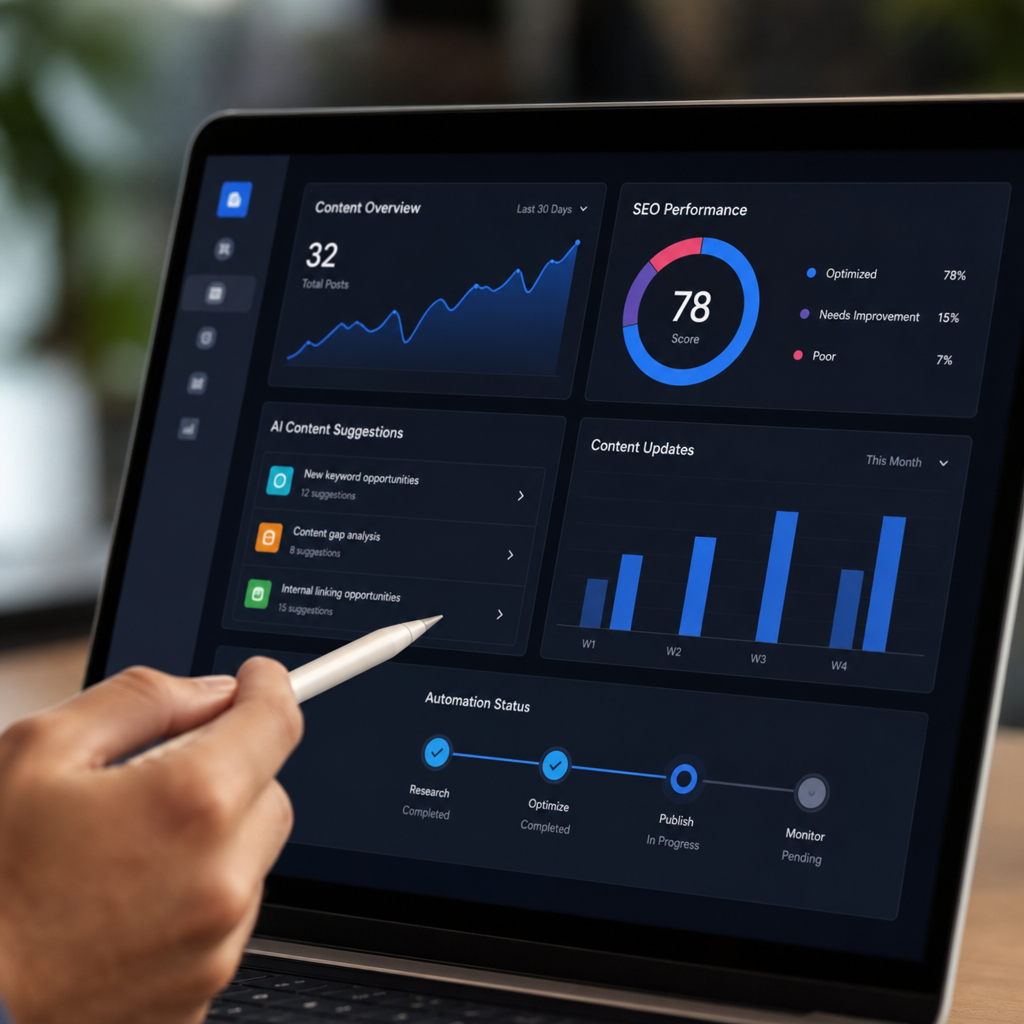
This is where the "best way to keep a blog updated" question has genuinely shifted in the last couple of years. AI-driven content platforms have matured to the point where they can research keywords, write structured, readable articles, and publish them directly into a CMS — without a human writer touching every step.
FrontRank is built specifically around this workflow. It connects directly to WordPress, Webflow, Wix, Shopify, Ghost, or Framer in one click — no API keys, no copy-pasting drafts into the CMS, no writer to brief. It builds the content calendar, generates the keyword targets, writes the articles, and publishes them on a daily schedule automatically. The blog updates itself, on schedule, indefinitely.
For a small business owner, this means the blog gets the consistency of an agency retainer without the monthly management overhead. For an agency managing several client sites, it means every client's blog can run on autopilot instead of eating into the team's bandwidth.
What "Keeping a Blog Updated" Should Actually Mean
Publishing frequency alone isn't the goal — it's a proxy for something more important: staying relevant to what people are actively searching for, and staying visible to both search engines and the AI assistants that increasingly summarize search results.
A genuinely well-maintained blog does four things on an ongoing basis:
- Targets new keywords as search behavior shifts. Static content ages; search intent doesn't stand still.
- Reinforces topical authority. Google's helpful content guidance rewards sites that demonstrate depth across a subject, not just one-off posts.
- Feeds AI answer engines. Tools like ChatGPT and Perplexity increasingly cite structured, frequently updated web content when generating answers — a trend covered extensively by Search Engine Land.
- Builds internal links and site structure. Every new post is a new entry point for organic traffic and a new opportunity to link to product or service pages.
This is the deeper reason "post once a month when you remember" doesn't work. It's not really about frequency for its own sake — it's about whether your site continues to look, to Google and to AI crawlers, like a living, authoritative resource on your topic.
A Realistic Publishing Cadence
Not every business needs to publish daily to see results, but cadence matters more than most owners assume. Here's a rough framework for how publishing frequency maps to typical outcomes over a 6–12 month window, based on patterns commonly reported in SEO industry analyses.
| Frequency | Typical Outcome Over 6–12 Months | Best Suited For |
|---|---|---|
| Less than once a month | Minimal ranking movement, blog looks abandoned | Not recommended |
| 1–2 posts/month | Slow, gradual keyword coverage | Very small niches, limited budgets |
| 1 post/week | Steady growth in impressions and rankings | Most small businesses |
| 3–5 posts/week | Rapid topical authority build, faster AI citation pickup | Competitive niches, agencies, eCommerce |
| Daily | Fastest coverage of long-tail keywords, strongest AI visibility | Businesses aiming to dominate a category |
Higher frequency isn't about spamming the internet with thin content — it's about covering the full breadth of questions your customers are already typing into Google and into AI chat tools. A platform that automatically generates a calendar and writes to it daily, like FrontRank, makes the higher end of this table achievable without the labor cost that used to make it impractical.

Setting Up a System That Doesn't Depend on Willpower
Whichever method you choose, the underlying principle is the same: the best way to keep a blog updated is to remove yourself as the bottleneck. Here's a practical checklist for building a system that survives busy weeks, staff turnover, and shifting priorities.
- Separate planning from writing. Build (or generate) a content calendar in advance so nobody has to think of a topic on the day.
- Automate keyword research. Manually finding keyword opportunities every week doesn't scale; tools that continuously mine keyword data keep the calendar fresh.
- Standardize formatting. Templates for headings, meta descriptions, and internal linking save editing time and keep quality consistent.
- Publish directly into the CMS. Every manual copy-paste step is a place where publishing can stall for days or weeks.
- Review performance periodically, not obsessively. Check rankings and traffic monthly, not daily, to avoid decision fatigue.
- Make the system CMS-agnostic where possible. If you manage or might migrate between WordPress, Shopify, Webflow, or others, choose tools that support multiple platforms rather than locking yourself into one.
This is precisely the gap FrontRank was built to close — the platform combines calendar generation, keyword research, writing, and direct publishing into one connected workflow, so none of those six steps depends on a human remembering to do them.
Why Reliability Matters More for Agencies
Agencies face a version of this problem multiplied across every client account. A single missed publishing week for one client is a minor issue; the same lapse across fifteen accounts is a genuine service failure and a churn risk. Agencies that want to offer blogging as part of their retainer without hiring a writing team increasingly lean on automated tools precisely because reliability, not creativity, is the deliverable clients are actually paying for.
It's also worth noting that a consistent publishing cadence supports the rest of an agency's technical work. Good technical SEO and clean infrastructure matter, but they don't replace fresh content — they complement it. In the same way an agency might rely on trusted infrastructure partners like nexussecurityserviceses.com to keep client sites secure and stable behind the scenes, they can rely on an automated content pipeline to keep the front-facing blog active without adding headcount.
Common Mistakes That Undermine Consistency
Even businesses that intend to keep a blog updated regularly often trip on a few recurring mistakes:
- Publishing without keyword targeting. A post with no clear search intent behind it rarely earns traffic no matter how well it's written.
- Ignoring old posts. Updating existing content that's slipped in rankings is often faster than writing something new, and search engines reward freshness.
- Ambitious launches followed by silence. A ten-post launch week is impressive, but if it isn't followed by a sustainable cadence, it doesn't help long-term rankings.
- No internal linking strategy. New posts should link to product pages, service pages, and each other — isolated posts do less work than a connected content hub.
- Treating the blog as separate from SEO strategy. Blog content should map to the keywords the business actually wants to rank for, not just whatever topic came to mind that week.
Avoiding these mistakes is less about talent and more about process — which again points back to why a structured, automated system tends to outperform ad-hoc effort over the long run.
Final Thoughts
There is no single trick to keeping a blog updated — there's only the decision to build a system that doesn't rely on someone finding spare time. DIY writing, freelancers, and agencies can all work, but each depends on ongoing human bandwidth that tends to shrink exactly when a business gets busier and needs marketing the most.
That's the gap FrontRank was built to close. It connects to your CMS in one click, builds the content calendar, researches the keywords, writes the articles, and publishes them automatically — daily, if you want — so the blog keeps growing whether or not anyone on the team has time to think about it that week. For small business owners, eCommerce stores, and agencies managing multiple client sites, frontrank.com turns "we should really update the blog" from a recurring guilt trip into a task that's already been handled.
Article written by FrontRank