
Ask ChatGPT, Perplexity, or Google's AI Overviews a question about your industry, and within seconds you'll see a handful of websites named as sources. Some are massive publishers. Others are small, niche businesses that simply answered the question better than anyone else. If you've ever wondered why your competitor's blog post shows up in an AI-generated answer and yours doesn't, you're asking the right question — and it's one that's quickly becoming as important as "how do I rank in Google."
Understanding how do AI assistants choose which websites to cite is no longer a niche technical curiosity. It's becoming a core part of how customers discover businesses in 2026, as more people skip traditional search results entirely and go straight to an AI chat window for answers. This article breaks down the seven factors that most consistently influence citation, backed by what's publicly known about how these systems work, and what small business owners and agencies can actually do about it.
Why This Question Matters More Than Ever in 2026
Search behavior has shifted. A growing share of consumers now ask ChatGPT, Claude, Perplexity, or Google's Gemini-powered AI Overviews for recommendations instead of typing a query into a traditional search box and scrolling through ten blue links. When an AI assistant answers "what's the best project management software for small teams" or "how do I choose a moving company," it pulls information from a limited set of sources and names them directly.
That's a fundamentally different game than classic SEO. In traditional search, your page just needs to rank in the top ten to get traffic. In the AI answer era, there might only be three to six sources cited in an entire response — and if you're not one of them, you don't exist in that conversation at all. This emerging discipline is often called GEO (Generative Engine Optimization), and it runs alongside — not instead of — traditional SEO.
How AI Assistants Actually Generate Answers
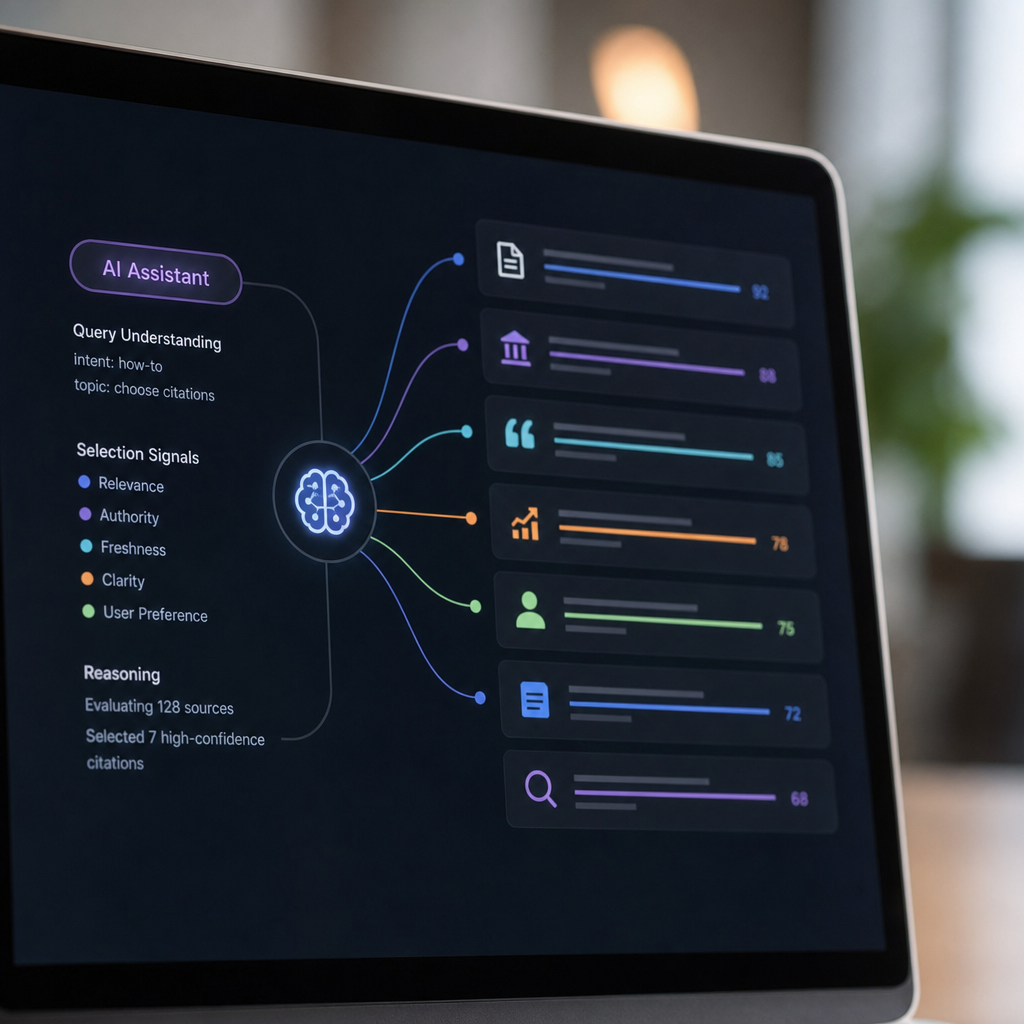
Before diving into the ranking factors, it helps to understand the basic mechanics. Most AI assistants that cite sources — including Perplexity, ChatGPT with browsing, and Google's AI Overviews — follow a similar general pattern:
- Query interpretation – the assistant breaks down what you're actually asking, including intent and context.
- Retrieval – it searches an index (sometimes its own, sometimes a real-time web search) for relevant, high-quality pages.
- Ranking and filtering – candidate pages are scored for relevance, trustworthiness, and recency.
- Synthesis – the model summarizes information from the top-ranked sources into a coherent answer.
- Citation – links or source names are attached to the claims the model makes, usually pulling from the pages it weighted most heavily in step 3.
This is why many SEO practitioners describe GEO as "SEO plus retrieval." Your content still has to be findable and relevant, like in classic search, but it also has to be structured in a way that's easy for a language model to extract, quote, and attribute confidently.
The 7 Factors That Influence Whether AI Assistants Cite You
1. Clear, Direct Answers Near the Top of the Page
AI assistants favor content that states the answer plainly, rather than burying it under a long narrative introduction. Pages that open with a direct definition, a concise summary, or a clear numbered process tend to get pulled into AI answers more often than pages that make the reader scroll through backstory first. This mirrors what Google has said for years about featured snippets, and the underlying logic is similar: models reward content that minimizes the work needed to extract a usable answer.
2. Structured, Well-Organized Content
Headings, bullet lists, numbered steps, and tables make it far easier for a retrieval system to identify and extract specific facts. Unstructured walls of text are harder for a model to parse accurately, which means they're less likely to be quoted correctly — or cited at all. This is one of the most practical, controllable factors on this list.
3. Demonstrated Expertise and Original Information
Google's long-standing E-E-A-T guidance (Experience, Expertise, Authoritativeness, Trustworthiness) has carried over directly into how generative engines weigh sources. Content that reflects first-hand experience, original data, or a specific point of view is more likely to be treated as a credible source than generic, reworded summaries of what's already on the web. If your blog post says the same thing as fifty other blog posts, there's little reason for the model to cite you specifically over a more established competitor.
4. Freshness and Update Frequency
AI assistants, particularly those with live web access, tend to favor content that has been recently published or updated. A blog that hasn't posted in eight months signals staleness, while a blog publishing consistently signals that it's actively maintained and more likely to reflect current information. This is one of the biggest reasons a regularly updated blog outperforms a static "About" page stuffed with keywords.
5. Topical Depth and Site-Wide Authority
A single great article helps, but AI systems — much like traditional search engines — also weigh the broader context of the domain. A site with dozens of well-organized, interlinked articles covering a topic area in depth looks more authoritative than a single orphaned post. This is why businesses that maintain an actual content library, rather than three blog posts published two years apart, show up more consistently in AI citations over time.
6. Technical Accessibility
If a crawler can't read your page, it can't cite it — no matter how good the content is. That means clean HTML, reasonable page speed, no aggressive paywalls or bot-blocking, and a logical site structure all matter. Cloudflare's research on AI crawler traffic has shown a dramatic rise in bots like GPTBot and PerplexityBot, and sites that block or mishandle these crawlers simply remove themselves from consideration.
7. External Validation and Mentions Elsewhere
Just like backlinks shaped classic SEO, being mentioned, quoted, or linked to from other reputable sites appears to reinforce a page's credibility in the eyes of generative engines. If your brand or article is referenced across multiple trustworthy domains, models encounter consistent signals that you're a legitimate source on the topic, not an isolated claim with no corroboration. HubSpot's research team and other industry publishers have noted this pattern repeatedly in their own AI visibility tracking.
Traditional SEO vs. AI Citation Optimization
It's tempting to assume that ranking well in Google automatically means getting cited by AI assistants. There's real overlap, but the two aren't identical. Here's how they compare:
| Factor | Traditional SEO Ranking | AI Assistant Citation |
|---|---|---|
| Primary goal | Rank in top 10 search results | Be one of 3-6 sources quoted in an answer |
| Content format | Long-form, keyword-optimized | Direct answers, scannable structure |
| Key signal | Backlinks, keyword relevance | Clarity, extractability, topical depth |
| Freshness weight | Moderate | High, especially for fast-moving topics |
| Success metric | Click-through rate, rankings | Share of citations, brand mentions |
| Update cadence needed | Periodic | Frequent and consistent |
The practical takeaway: optimizing for AI citation doesn't mean abandoning SEO fundamentals. It means tightening them — clearer structure, more original substance, more frequent publishing — so your content works for both human searchers and machine retrieval systems at the same time.
What Small Businesses Get Wrong About AI Citations
Most small business owners and even some agencies make a handful of predictable mistakes when trying to get cited by AI tools. Understanding these pitfalls is often more useful than chasing the latest algorithm theory.
- Publishing too infrequently. A blog with four posts from 2024 signals inactivity, not authority.
- Writing vague, generic content that doesn't actually answer the question a customer would type into ChatGPT.
- Ignoring page structure, burying the answer in paragraph six instead of paragraph one.
- Treating the blog as a side project rather than a core discovery channel, the same way a storefront or product page would be treated.
- Assuming AI citation is a one-time fix rather than an ongoing content commitment, similar to how SEO rankings require sustained effort, not a single optimized page.
The businesses that do get cited consistently tend to share one trait: they publish useful, specific, well-structured content on a predictable schedule, not in sporadic bursts.
A Simple Framework for Getting Cited More Often
If you want to improve your odds of being the website an AI assistant names, a practical framework looks like this:
- Identify the real questions your customers ask — not just keywords, but the actual phrasing people use when they're deciding, comparing, or troubleshooting.
- Answer the question in the first two sentences, then expand with detail, examples, and nuance afterward.
- Use structure deliberately — headings for each sub-question, bullet points for lists, tables for comparisons.
- Publish consistently, ideally weekly or more, so your site demonstrates ongoing authority rather than a one-time effort.
- Interlink your own content so that a model (and a human) can see you've covered the topic area in depth, not just once.
- Keep technical access open so crawlers like GPTBot, PerplexityBot, and Googlebot can read and index your pages without friction.
This is precisely the kind of work that's easy to describe and genuinely hard to sustain without dedicated time or a team — which is exactly where most small businesses and agencies get stuck.
Comparing Approaches to Building a Citation-Worthy Blog
Business owners generally have three realistic paths to building the kind of content library that gets picked up by AI assistants. Here's how they stack up:
| Approach | Typical Cost | Consistency | Time Required From Owner | AI/SEO Suitability |
|---|---|---|---|---|
| Do it yourself | Free (your time) | Often inconsistent | High — hours per week | Weak unless highly disciplined |
| Hire a freelance writer or agency | $500–$3,000+/month | Depends on contract | Low to moderate | Good, but slow to scale across sites |
| Automated AI publishing (e.g. FrontRank) | Flat monthly fee | Daily, scheduled | Minutes to connect, then hands-off | Strong — built for structure, consistency, and GEO |

This is where a platform like FrontRank fits into the picture. Rather than asking a business owner to become a part-time content strategist, FrontRank connects directly to a CMS — WordPress, Webflow, Wix, Shopify, Ghost, or Framer — in a single click, with no API keys, no copy-paste, and no writing required from the business. It builds the content calendar, researches keywords, writes structured, direct-answer articles, and publishes them automatically on a daily schedule. That consistency and structure are exactly the two levers that matter most for AI citation, based on everything outlined above.
Why Consistency Beats One-Off Optimization
It's worth repeating this point because it's the one most businesses underestimate: a single perfectly optimized article will not reliably get you cited by AI assistants. What builds citation share over time is topical depth across dozens of interlinked, well-structured, regularly updated articles. Google's own search quality documentation has emphasized this kind of sustained, demonstrated expertise for years, and generative engines appear to be reinforcing the same pattern rather than inventing a new one.
This is also why agencies managing multiple client sites face a scaling problem. Producing one or two well-optimized posts a month per client might sound sufficient, but it rarely builds the depth needed for consistent AI citation across even a handful of accounts — let alone a full roster of clients. Automating the research, writing, and publishing workflow, as FrontRank does, turns what used to require a full content team into a system that runs quietly in the background for every client site at once.
Monitoring Whether Your Site Is Actually Getting Cited
Optimizing blindly isn't a strategy. Business owners and agencies should periodically check whether their efforts are translating into actual AI citations. A few practical ways to do this:
- Ask the assistants directly. Periodically query ChatGPT, Perplexity, and Google's AI Overviews with the exact questions your content answers, and note whether your site appears.
- Watch referral traffic. Many analytics platforms now show referral traffic from chat.openai.com, perplexity.ai, and similar domains — a jump here often means a citation drove a click.
- Track brand mentions, even unlinked ones, using tools that monitor web mentions, since models sometimes reference a business by name without a direct link.
- Review crawler logs to confirm bots like GPTBot and PerplexityBot are actually accessing your site regularly.
Over time, these checks reveal whether your content strategy is working the way it's supposed to, rather than guessing based on traffic numbers alone.
Final Thoughts
Understanding how do AI assistants choose which websites to cite comes down to a fairly consistent set of principles: clear and direct answers, strong structure, genuine expertise, technical accessibility, freshness, topical depth, and outside validation. None of these are secret tricks — they're the same fundamentals that have always separated trustworthy, useful content from filler. What's changed is the stakes: with AI assistants naming only a handful of sources per answer, the businesses that commit to consistent, well-structured publishing are the ones that keep showing up, while the rest quietly disappear from the conversation.
For small business owners, eCommerce brands, and agencies who know they need a blog but don't have the time, team, or appetite to manage one manually, this is precisely the gap FrontRank was built to close. By connecting directly to your CMS and handling the calendar, the keyword research, the writing, and the daily publishing automatically, frontrank.com gives businesses a real, working blog that's built from the ground up to rank in Google and get cited by AI assistants — without hiring writers or paying for an agency retainer.
Article written by FrontRank