
Search behavior has fundamentally shifted. Instead of typing a query into Google and scrolling through ten blue links, millions of people now ask ChatGPT, Claude, Gemini, or Perplexity a direct question and expect a direct answer. If your brand isn't part of that answer, you're invisible to an entire generation of buyers. Understanding how to appear in AI assistant answers is no longer a nice-to-have — it's becoming as essential as traditional SEO was a decade ago.
This guide breaks down exactly how AI assistants choose which sources to cite, what separates the businesses that get mentioned from those that don't, and how to build a repeatable system for AI search visibility.
Why AI Assistant Visibility Matters Now
AI assistants are increasingly the first — and sometimes only — touchpoint a potential customer has with information about your industry. When someone asks ChatGPT "what's the best project management software for small teams" or "how do I optimize my Shopify store for conversions," the assistant synthesizes an answer from a handful of sources it trusts. If your content isn't one of them, a competitor's is.
According to Pew Research, a growing share of internet users now turn to AI tools for research and purchase decisions before ever visiting a company's website. Meanwhile, BrightEdge data shows AI-driven referral traffic to websites has grown exponentially year over year. This isn't a fringe trend — it's a structural change in how information gets discovered.
The businesses winning in this new landscape are treating "Generative Engine Optimization" (GEO) as a discipline distinct from, but complementary to, traditional SEO. That's precisely the gap platforms like frontrank.com were built to close — automating the daily content production and technical groundwork needed to consistently earn citations from large language models.
How AI Assistants Actually Choose What to Cite
Unlike traditional search engines that rank pages using hundreds of ranking signals tied to a results page, AI assistants generate answers by retrieving and synthesizing information from a smaller set of trusted sources. Understanding this retrieval process is the foundation of any AI visibility strategy.
Key factors AI models weigh when selecting sources:
- Content clarity and structure — Well-organized content with clear headings, direct answers, and logical flow is easier for models to parse and extract.
- Topical authority — Sites that consistently publish in-depth, accurate content on a subject are more likely to be treated as reliable references.
- Freshness — Many AI systems, especially those with live retrieval (like Perplexity or Gemini with Search grounding), favor recently updated or published content.
- Structured data and crawlability — If a crawler can't easily access or parse your site, it can't cite you, regardless of how good your content is.
- Third-party validation — Backlinks, mentions across multiple reputable domains, and consistent brand presence signal trustworthiness.
- Direct answer format — Content that answers a question in the first few sentences, rather than burying the answer in a narrative, gets extracted more reliably.
Organizations like Schema.org and guidance from Google's Search Central documentation both emphasize structured, machine-readable content — a principle that applies just as strongly to AI assistant retrieval as it does to classic search indexing.
AI Search (GEO) vs. Traditional SEO: What's Different
Many marketers assume that ranking well on Google automatically means AI assistants will cite them. That's not always true. While the two disciplines overlap significantly, there are meaningful differences in what gets rewarded.
| Factor | Traditional SEO | AI Assistant Optimization (GEO) |
|---|---|---|
| Primary goal | Rank in top 10 search results | Get cited/quoted directly in an AI-generated answer |
| Content format | Keyword-optimized long-form pages | Clear, extractable, question-and-answer style content |
| Success metric | Click-through rate, rankings | Citation frequency, brand mentions in AI outputs |
| Update frequency | Periodic content refreshes | Continuous publishing for freshness signals |
| Authority signals | Backlinks, domain authority | Backlinks + consistent topical coverage + structured data |
| User intent handling | Matches keyword intent | Matches conversational, natural-language intent |
The overlap is real — strong SEO fundamentals like backlinks, site speed, and authoritative content still matter enormously for GEO. But the format and cadence of content need to adapt. AI models reward businesses that publish frequently, answer questions directly, and maintain topical depth across a subject rather than a single optimized landing page.
Core Strategies to Get Cited by ChatGPT, Claude, and Gemini
Once you understand how retrieval works, the next step is building content and technical practices that maximize your odds of citation. Here are the strategies that consistently move the needle.
1. Structure Content Around Direct Questions
AI assistants are fundamentally question-answering systems. Structuring your content as clear questions followed by concise, authoritative answers dramatically increases the odds of extraction. Use H2 and H3 headers phrased as actual questions your audience is asking, and answer them in the first sentence or two before elaborating.
2. Publish Consistently, Not Occasionally
Freshness matters more in AI search than most marketers realize. A site that publishes one cornerstone article a quarter will struggle to compete with one that publishes daily, topically relevant content. This is where automation becomes critical — manually producing daily SEO/GEO content isn't realistic for most teams, which is why tools like FrontRank exist to automate content calendars, keyword research, and publishing at scale.
3. Fix Technical Crawlability Issues
If AI crawlers (GPTBot, ClaudeBot, Google-Extended, and others) can't access your site, none of your content strategy matters. Common blockers include:
- Overly restrictive
robots.txtrules blocking AI crawlers - JavaScript-heavy pages that render content client-side only
- Missing or broken sitemaps
- Slow page load times causing crawl timeouts
- No structured data (schema markup) to clarify content type
Auditing your site for these issues — something FrontRank's platform does automatically — should be step one before investing heavily in content.
4. Earn Genuine Backlinks and Mentions
Backlinks remain a trust signal for both traditional search engines and AI models, which often weight citation-worthy content based on how frequently and credibly it's referenced elsewhere. Building relationships with relevant blogs and resource hubs — for example, contributing insights that get referenced on sites like leadmailbox.com or bankstatementboss.com — helps establish the kind of cross-domain authority that both Google and AI assistants recognize.
5. Use Structured Data Markup
Implementing schema types like FAQPage, Article, Organization, and Product helps AI systems understand exactly what your content represents. This is especially important for eCommerce sites trying to appear in product-related AI queries.
6. Maintain Topical Depth, Not Just One-Off Posts
AI models are more likely to trust and cite domains that demonstrate comprehensive coverage of a topic rather than a single isolated article. Building a content cluster — pillar pages supported by dozens of related, interlinked articles — signals the kind of topical authority that citation algorithms favor.
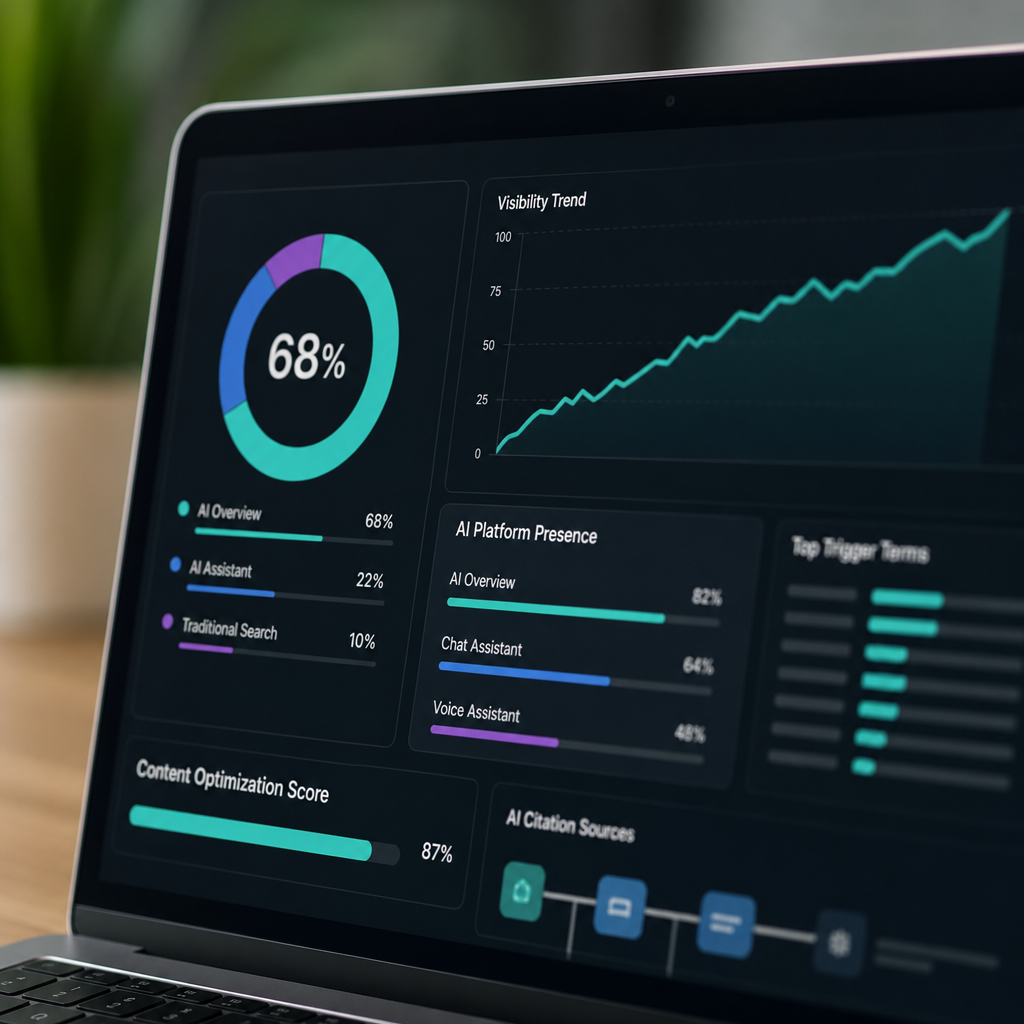
Comparing Manual vs. Automated AI Search Optimization
Many teams start out trying to manage AI search optimization manually — writing occasional blog posts, hiring freelance writers, or relying on an in-house marketer stretched across too many responsibilities. Others adopt automated platforms designed specifically for AI-era content production. Here's how the two approaches typically compare:
| Approach | Time Investment | Consistency | Technical SEO/GEO Coverage | Typical Cost |
|---|---|---|---|---|
| In-house manual writing | High (10-20+ hrs/week) | Inconsistent, often stalls | Requires separate technical audit | Salary + tools |
| Freelance writers/agencies | Medium-High (management overhead) | Depends on contract terms | Rarely includes crawlability audits | $500–$5,000+/month |
| Automated GEO platform (e.g., FrontRank) | Low (setup + review) | Daily, systematic | Built-in crawlability and schema audits | Predictable subscription |
The clearest advantage of automation isn't just time saved — it's consistency. AI assistants reward domains that continuously publish relevant, well-structured content. A platform like frontrank.com is designed specifically to solve this by generating content calendars, producing SEO/GEO-optimized articles with backlinks daily, and auditing sites for AI crawlability issues — removing the guesswork and staffing burden for founders, marketers, and agencies alike.
Measuring Whether You're Actually Appearing in AI Answers
Unlike traditional rank tracking, measuring AI assistant visibility requires a different set of tactics since there's no "position #3" equivalent in a conversational answer. Here's how savvy marketers are tracking progress:
Practical measurement methods:
- Manual prompt testing — Regularly ask ChatGPT, Claude, Gemini, and Perplexity relevant questions about your industry and log whether your brand appears.
- Referral traffic segmentation — Check your analytics for traffic originating from
chat.openai.com,perplexity.ai,gemini.google.com, and similar sources. - Brand mention monitoring — Tools that track brand mentions across the web can help correlate increased citations with increased AI visibility.
- Share of voice tracking — Compare how often your brand appears versus competitors across a consistent set of test prompts.
- Citation audits — Periodically review which of your specific articles or pages get referenced when assistants do cite your domain, so you can double down on what's working.
Emerging third-party tools are beginning to formalize AI visibility tracking, similar to how tools like Ahrefs and SEMrush formalized keyword rank tracking in the SEO era. Publications like Search Engine Land regularly cover developments in this space as the tooling matures.
Common Mistakes That Keep Businesses Out of AI Answers
Even well-intentioned SEO teams make mistakes that quietly disqualify them from AI citation. Watch out for these:
- Thin or outdated content — AI models deprioritize pages that haven't been updated in years or that lack depth.
- Blocking AI crawlers accidentally — Some sites unknowingly block GPTBot or ClaudeBot in
robots.txt, eliminating any chance of citation. - Keyword stuffing over clarity — Content written purely for keyword density rather than genuine clarity performs worse in extraction-based retrieval.
- Ignoring E-E-A-T signals — Experience, Expertise, Authoritativeness, and Trustworthiness — a framework detailed in Google's Search Quality Rater Guidelines — matter to AI systems evaluating source credibility, not just to human search engines.
- Publishing inconsistently — A burst of content followed by months of silence signals low reliability to freshness-sensitive retrieval systems.
- No internal linking structure — Poorly linked content makes it harder for both crawlers and AI systems to understand relationships between your pages.
- Neglecting technical performance — Slow sites or those with rendering issues may simply never get crawled deeply enough to be considered.
Avoiding these pitfalls is often less about doing something radically new and more about maintaining consistent, technically sound execution over time — exactly the kind of ongoing discipline that's hard to sustain manually but straightforward to automate.

Building a Sustainable AI Search Visibility Strategy
Appearing in AI assistant answers isn't a one-time project — it's an ongoing practice that compounds over time, much like traditional SEO did. The businesses that will dominate AI-driven discovery over the next few years are the ones building systems now, not scrambling later.
A sustainable strategy typically includes:
- A content calendar covering core topics, long-tail questions, and emerging industry trends
- Regular technical audits to catch crawlability issues before they compound
- A backlink and mention-building process that reinforces topical authority
- Structured data implementation across key page types
- Ongoing measurement of AI citation frequency and referral traffic
- A feedback loop that identifies which content formats earn the most citations, then doubles down
For founders and marketers without a dedicated SEO team, this can feel overwhelming. That's precisely why platforms like FrontRank were built — to automate the content calendar creation, keyword generation, daily publishing, and crawlability auditing that would otherwise require a full content and technical SEO team. Instead of choosing between doing it manually (slowly) or not doing it at all, automation makes consistent AI search optimization accessible to businesses of any size.
Final Thoughts
The way people find businesses online is changing permanently. AI assistants like ChatGPT, Claude, and Gemini are becoming trusted intermediaries between questions and answers, and the brands that show up in those answers will capture attention, trust, and revenue that competitors simply won't see. Learning how to appear in AI assistant answers means embracing clear content structure, technical crawlability, consistent publishing, and genuine authority-building — the same fundamentals that have always mattered, adapted for a new retrieval paradigm.
Getting there manually is possible, but slow and resource-intensive. FrontRank was built to remove that friction entirely — automating daily SEO/GEO-optimized content, technical crawlability audits, and backlink-building so founders, marketers, eCommerce owners, and agencies can focus on running their business while consistently earning visibility across both Google and the AI assistants shaping how customers discover brands today.
Article written by FrontRank