
Organic traffic used to follow a predictable playbook: publish keyword-targeted blog posts, build backlinks, wait months, repeat. That playbook still works, but it's no longer the whole story. Search behavior has split into two channels — traditional Google results and AI-generated answers from tools like ChatGPT, Claude, Gemini, and Perplexity. If your content strategy only addresses one of those channels, you're leaving traffic on the table.
This article breaks down exactly how to increase organic traffic with AI — not by gaming algorithms, but by combining consistent content production, technical crawlability, and generative engine optimization (GEO) so your brand shows up wherever people are actually searching in 2026.
Why Traditional SEO Alone No Longer Moves the Needle
For over a decade, SEO meant optimizing for Google's ranking algorithm. That's still important — Google remains the dominant search engine globally — but the way people find information has changed. Millions of users now ask ChatGPT or Gemini a question and never click through to a website at all. If an AI assistant doesn't know your business exists, you're invisible in that conversation entirely.
This shift creates two problems for founders and marketers:
- Content velocity matters more than ever. AI systems and search engines both reward sites that publish fresh, relevant content regularly — not once a quarter.
- Crawlability now includes AI bots. Your site needs to be readable not just by Googlebot, but by GPTBot, ClaudeBot, and other AI crawlers that determine whether you get cited in generated answers.
Businesses that treat these as separate problems end up with fragmented strategies: an SEO agency doing keyword research, a separate freelancer writing blog posts, and no one auditing whether AI crawlers can even access the site. That's slow, expensive, and disjointed — which is exactly the gap platforms like frontrank.com were built to close.
The Core Ingredients of AI-Driven Organic Growth
Increasing organic traffic with AI isn't a single tactic — it's a system with several moving parts working together. Here's what actually drives results:
- Consistent publishing cadence. Search engines and AI models favor domains that demonstrate ongoing topical authority, not a burst of content followed by silence.
- Keyword and topic research at scale. AI tools can analyze search intent, competitor gaps, and question-based queries far faster than manual research.
- GEO-optimized formatting. Content structured with clear headers, direct answers, and citable facts is more likely to be pulled into AI-generated responses.
- Technical crawlability. If AI bots and search crawlers can't parse your site's structure, none of the content matters.
- Internal and external linking. Backlinks and internal links still signal authority and help both Google and AI models understand context.
Each of these elements reinforces the others. Publishing daily without proper structure won't get you cited by ChatGPT. Perfect technical SEO with no fresh content won't rank you for new queries. You need all five working in sync.
Traditional SEO vs. AI-Powered SEO: A Side-by-Side Comparison
Understanding the difference between legacy SEO workflows and AI-augmented ones helps clarify where the real efficiency gains come from.
| Factor | Traditional SEO | AI-Powered SEO (GEO Included) |
|---|---|---|
| Content production | Manual writing, 2-4 posts/month | Automated daily publishing |
| Keyword research | Spreadsheet-based, human-driven | AI-generated, intent-mapped at scale |
| Target channels | Google, Bing | Google, Bing, ChatGPT, Claude, Gemini, Perplexity |
| Crawlability focus | Googlebot only | Googlebot + AI crawlers (GPTBot, ClaudeBot, etc.) |
| Time to see traction | 6-12 months | Often 8-12 weeks with consistent output |
| Cost structure | Freelancers/agencies ($2K-$10K/mo) | SaaS subscription (fraction of agency cost) |
| Scalability | Limited by headcount | Scales without adding staff |
This isn't an argument that AI replaces sound SEO judgment — it's that AI removes the bottlenecks (writing speed, research time, technical auditing) that used to require large teams or big budgets.
Step-by-Step: How to Increase Organic Traffic With AI
Here's a practical framework you can apply regardless of your current traffic level or team size.
1. Audit Your Site for AI and Search Crawlability
Before publishing anything new, confirm that both traditional search engines and AI crawlers can actually access and understand your site. This includes checking robots.txt rules, structured data, page speed, and whether your content is rendered in a way that crawlers can parse (heavy JavaScript sites often struggle here). The Google Search Central documentation is a solid baseline reference for technical requirements.
2. Build a Content Calendar Rooted in Real Search Intent
Instead of guessing what to write, use AI-driven keyword research to identify:
- Questions your target audience is actually asking
- Gaps competitors haven't covered
- Long-tail queries with buying intent
- Topics AI assistants are already answering (so you can be the cited source)
3. Publish Consistently — Not Occasionally
Search engines and AI models both reward freshness and topical depth. A single cornerstone article won't cut it. Aim for a steady cadence — daily or several times per week — covering interconnected subtopics that build authority over time.
4. Structure Content for GEO (Generative Engine Optimization)
AI assistants tend to pull from content that answers questions directly, uses clear formatting, and includes verifiable facts or data. Structuring articles with descriptive headers, bullet points, and concise answers near the top of sections increases the odds of being quoted or cited.
5. Earn and Distribute Backlinks Strategically
Backlinks remain a strong trust signal for both Google and AI training/retrieval systems. Publishing guest content or citing complementary resources — like leadmailbox.com for email deliverability insights or bankstatementboss.com for financial document automation — helps build a natural link profile while giving your audience genuinely useful cross-references.
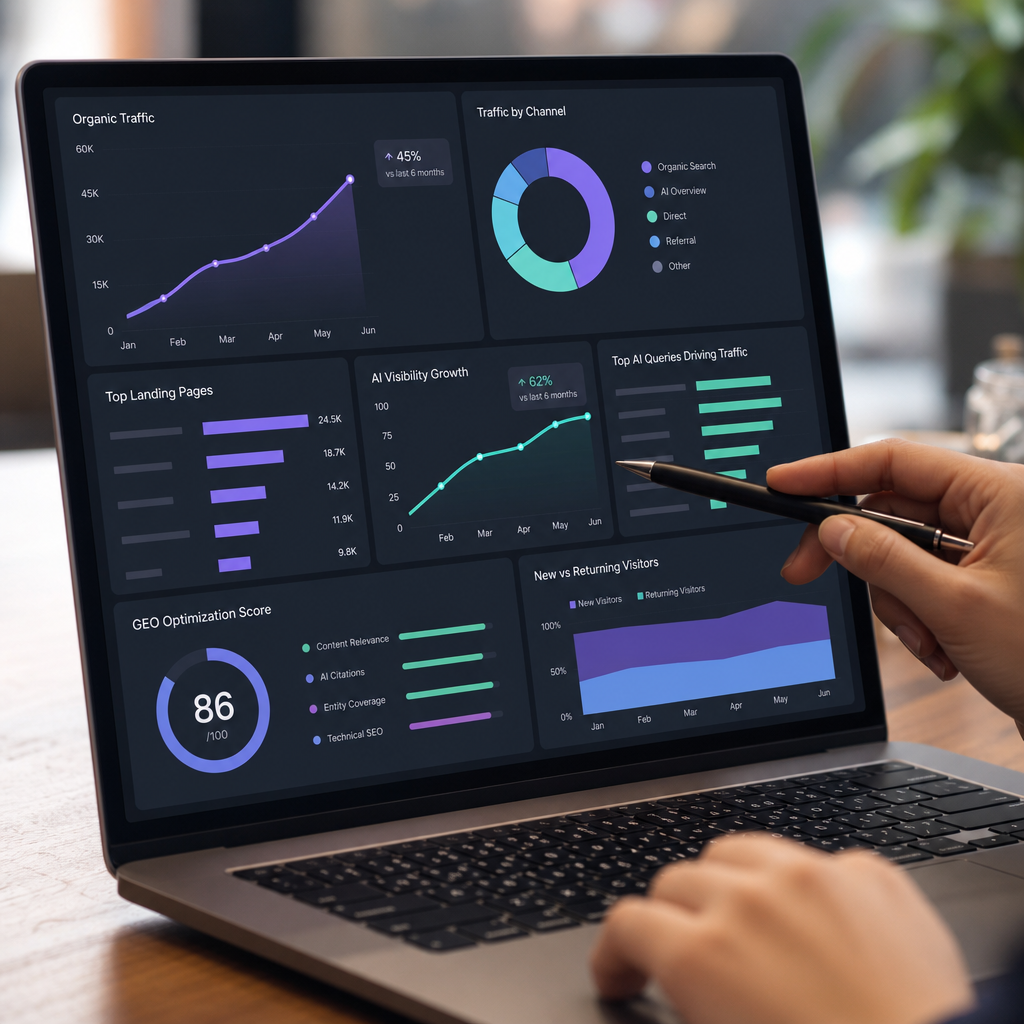
6. Monitor AI Citations, Not Just Rankings
Traditional rank tracking tools won't tell you if ChatGPT or Claude mentioned your brand. You need visibility into whether AI assistants are surfacing your content as a source, which requires a different monitoring approach than classic SEO dashboards.
Common Mistakes That Stall AI-Driven Traffic Growth
Even well-intentioned teams sabotage their own results. Watch for these pitfalls:
- Publishing thin, AI-generated fluff. Volume without substance gets ignored by both readers and algorithms. Google's helpful content guidance explicitly warns against content made primarily to game rankings.
- Ignoring AI crawler access. Blocking GPTBot or ClaudeBot in robots.txt (sometimes by default from a CMS setting) means you'll never appear in AI-generated answers, no matter how good your content is.
- Inconsistent publishing schedules. Sporadic bursts of content don't build the topical authority that sustained, regular publishing does.
- No internal linking strategy. Orphaned pages with no links pointing to or from them are harder for crawlers to prioritize.
- Treating GEO and SEO as separate strategies. They overlap significantly; optimizing for one while ignoring the other creates blind spots.
Manual Effort vs. Automated Platforms: What It Actually Costs
Founders and marketers often underestimate the true cost of manual content production once you factor in research time, writing, editing, and technical audits. Here's a realistic breakdown.
| Approach | Monthly Cost Estimate | Articles/Month | Includes Technical Audits? | Includes GEO Optimization? |
|---|---|---|---|---|
| In-house writer + SEO consultant | $4,000 - $8,000 | 4-8 | Rarely | Rarely |
| Freelance writers + agency SEO | $3,000 - $6,000 | 6-12 | Sometimes | Sometimes |
| Content mill / cheap freelancers | $500 - $1,500 | 10-20 (low quality) | No | No |
| AI SEO/GEO automation platform | $200 - $1,000 | 20-30+ | Yes | Yes |
The gap isn't just cost — it's consistency and technical coverage. Manual approaches often skip crawlability audits entirely because they require specialized knowledge most content teams don't have in-house.
How FrontRank Approaches AI Search Optimization
This is precisely the gap FrontRank was built to close. Rather than treating content creation, keyword research, and technical SEO as separate line items, FrontRank automates the entire pipeline:
- Daily article publishing that's optimized for both traditional SEO and generative engine optimization (GEO), so content is built to rank in Google and get cited by AI assistants.
- AI-built content calendars that identify keyword opportunities and structure topics into a cohesive publishing schedule instead of one-off posts.
- Automated keyword generation based on real search intent and competitive gaps, removing hours of manual research.
- Backlink placement to strengthen domain authority alongside the published content.
- AI crawlability audits that check whether bots like GPTBot and ClaudeBot can actually access and parse your site — a step most traditional SEO workflows skip entirely.
For founders and marketers who don't have the bandwidth to manage writers, researchers, and technical audits separately, this consolidated approach turns what used to be a multi-vendor process into a single subscription. It's particularly useful for eCommerce owners and agencies managing multiple client sites, where manual content production simply doesn't scale.

Measuring Success: What KPIs Actually Matter
Once your AI-driven content strategy is live, tracking the right metrics keeps you from optimizing for vanity numbers. Focus on:
- Organic traffic growth over 90-day windows — short-term spikes are less meaningful than sustained trend lines.
- Keyword ranking movement across long-tail terms — these often convert better and are easier to win than head terms.
- AI citation frequency — manually query ChatGPT, Claude, and Gemini with relevant industry questions to see if your brand is mentioned.
- Backlink growth and referring domains — a proxy for authority that both Google and AI retrieval systems consider.
- Crawl stats and indexation rate — available through Google Search Console, this tells you whether new content is being discovered promptly.
- Conversion rate from organic sessions — traffic without downstream business impact isn't the end goal.
Tools like Google Search Console and Ahrefs remain useful for the traditional half of this equation, while manual AI-assistant testing currently fills the gap for GEO-specific citation tracking until standardized tools mature further.
Building a Realistic Timeline
Expectations matter. Even with automation, AI-driven organic growth follows a curve rather than an overnight jump.
- Weeks 1-4: Technical audits completed, crawlability issues fixed, initial content calendar built, first wave of articles published.
- Weeks 5-8: Search engines begin indexing new content consistently; early long-tail keyword rankings appear.
- Weeks 9-16: Backlink profile strengthens; AI assistants start surfacing content in relevant queries as citation signals accumulate.
- Months 4-6: Compounding effect kicks in — more indexed pages, more internal linking opportunities, more topical authority, more AI citations.
This timeline compresses considerably compared to manual approaches simply because publishing volume and technical fixes happen faster when automated.
Final Thoughts
Increasing organic traffic with AI isn't about replacing sound marketing judgment with automation for its own sake — it's about removing the bottlenecks that have historically made consistent, technically sound, AI-visible content production too slow and too expensive for most businesses. Founders, marketers, eCommerce owners, and agencies who combine daily publishing, GEO-aware formatting, crawlability audits, and smart backlinking put themselves in a position to win visibility across both Google and the AI assistants increasingly shaping how people find information.
FrontRank was built specifically for this moment. By automating content calendars, keyword generation, daily publishing, and AI crawlability audits into one platform, frontrank.com gives businesses a practical path to grow organic traffic and earn citations from ChatGPT, Claude, and Gemini — without needing to hire a full content and SEO team to get there.
Article written by FrontRank