
Ask ChatGPT where to find the best running shoes, a reliable plumber, or project management software, and it will answer confidently, often naming specific brands. If your business isn't one of them, you've already lost a customer who never even opened Google. This shift is happening fast, and most small business owners don't yet know how to respond to it.
The good news: getting recommended by AI assistants isn't magic. It follows a logic you can understand and act on. This article breaks down exactly how AI assistants like ChatGPT, Gemini, Perplexity, and Claude decide what to recommend, and what you need to do to become one of their answers.
Why AI Assistants Recommend Some Businesses and Ignore Others
AI assistants don't "know" your business the way a human does. They generate answers based on patterns learned from training data and, increasingly, from real-time web content they retrieve when answering a query. This retrieval process, often called Retrieval-Augmented Generation (RAG), means tools like Perplexity and ChatGPT's browsing mode actively pull from current web pages to form their answers.
That means your visibility isn't about tricking an algorithm. It's about making sure your business has enough clear, structured, and credible content on the open web that an AI model can find it, understand it, and trust it enough to mention it by name.
A few things determine whether that happens:
- Content volume and freshness — do you publish enough relevant content for a model to associate your brand with a topic?
- Clarity and structure — is your content written in a way that's easy to extract facts from?
- Authority signals — do other reputable sites mention, link to, or cite your business?
- Consistency across the web — does your business show up the same way across multiple sources?
This is the foundation of what's now commonly called Generative Engine Optimization, or GEO — the practice of optimizing content specifically so AI systems cite and recommend it, rather than just ranking it in traditional search results.
The Difference Between SEO and GEO (and Why You Need Both)
Traditional SEO was built around ranking in a list of ten blue links. GEO is built around being the answer an AI assistant gives directly, often without the user ever clicking through to a website. These are related but distinct disciplines, and businesses that only optimize for one will miss opportunities in the other.
| Factor | Traditional SEO | Generative Engine Optimization (GEO) |
|---|---|---|
| Goal | Rank high in search results | Be cited or recommended in an AI-generated answer |
| Primary signal | Backlinks, keywords, page speed | Clear factual content, structure, topical authority |
| User action | Clicks a link | Reads the AI's answer directly |
| Content style | Keyword-optimized pages | Direct, well-structured, fact-dense answers |
| Measurement | Rankings, organic traffic | Brand mentions in AI answers, referral traffic from AI tools |
The overlap matters: Google's own Search Generative Experience and AI Overviews pull heavily from pages that already rank well organically. In other words, strong SEO fundamentals still matter enormously, they're just no longer the finish line. You need content built for both humans scanning search results and AI models scanning your content for facts to repeat.
What AI Assistants Actually Look For in Your Content
Large language models aren't reading your homepage once and memorizing it. They're synthesizing patterns from many sources, and the sources that get cited most often share specific traits. Research from Princeton's GEO study found that content optimized with clear statistics, quotations, and authoritative tone significantly increased citation visibility in generative answers.
Here's what consistently helps:
- Direct, declarative answers near the top of a page. AI models favor content that states a fact plainly rather than burying it in a long narrative lead-in.
- Structured formatting — headers, bullet points, tables, and numbered steps that are easy to parse and extract.
- Specific numbers, dates, and named entities. Vague claims ("we're the best") get ignored; specific claims ("we've served 4,200 customers since 2019") get cited.
- Freshness. Pages updated recently, or published on a consistent schedule, signal ongoing relevance.
- External validation. Mentions on third-party sites, review platforms, and industry publications reinforce that your brand is real and trustworthy.
This is also why businesses that publish only a handful of blog posts a year rarely get mentioned by AI tools. There simply isn't enough content volume for a model to build a confident association between your brand and the topics you want to be known for.
Building the Kind of Content AI Assistants Trust
If you want an AI assistant to say "you might consider [Your Business]" when someone asks a relevant question, your content needs to answer the exact questions your customers are already asking, in the exact places AI models are trained to look.
That starts with your own website. A blog that consistently covers your industry's common questions, comparisons, and how-to topics gives AI systems raw material to work with. It's not enough to have a static "About Us" page; you need an expanding library of content that demonstrates depth.
Consider the kinds of blog content that tend to earn AI citations:
- Comparison articles ("X vs. Y for small businesses")
- Definitional explainers ("What is [industry term] and why does it matter?")
- Step-by-step how-to guides
- Local and niche-specific resource pages
- Original data, case studies, or survey results
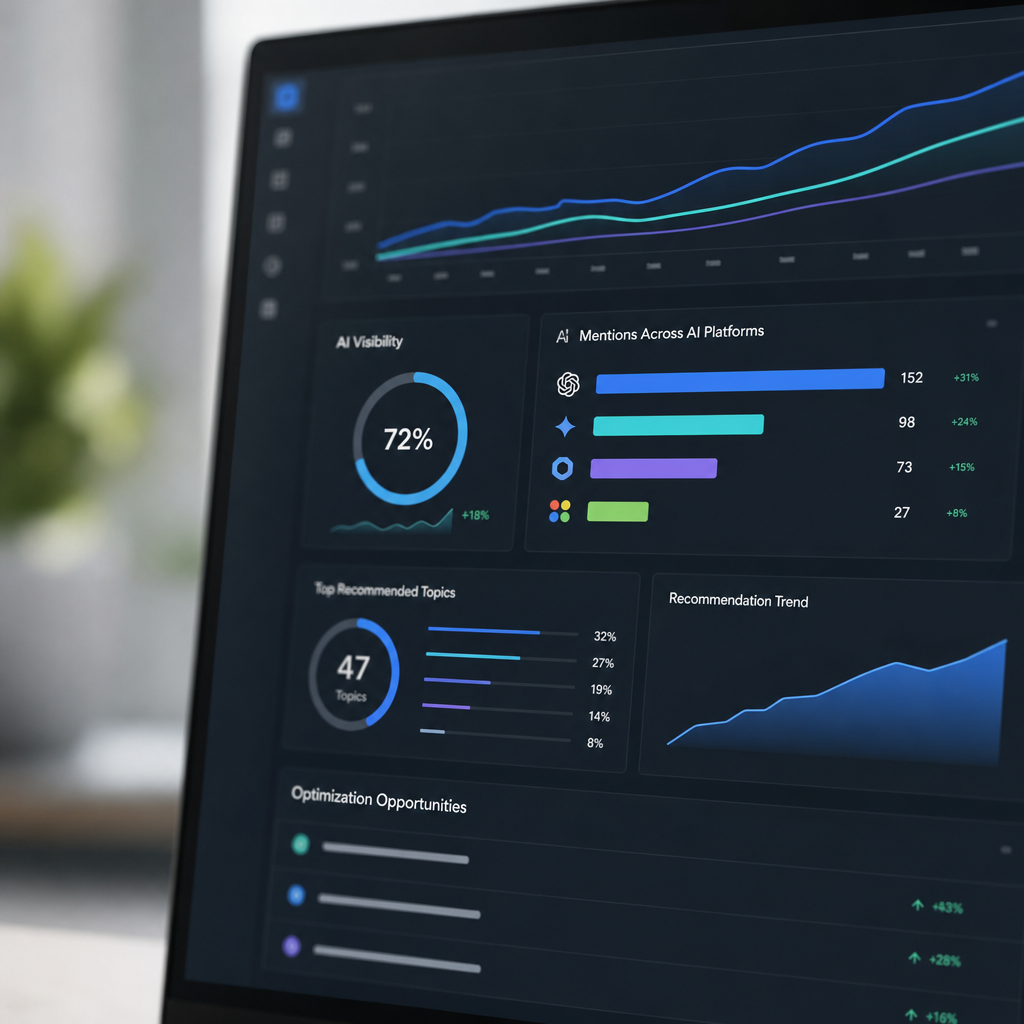
This is precisely the gap that FrontRank was built to close. Many small business owners know they need this kind of content but don't have the time, writing skill, or budget for an agency. FrontRank connects directly to your CMS, whether that's WordPress, Webflow, Wix, Shopify, Ghost, or Framer, and automatically builds a content calendar, researches keywords, writes full articles, and publishes them on a daily schedule. There's no API key setup, no copy-pasting drafts, and no hiring a writer. The blog simply starts working in the background, generating the volume and consistency of content that both Google and AI assistants reward.
Getting Your Business Found Through Structured Data and Citations
Beyond writing good content, there are technical and off-site steps that make it easier for AI systems to correctly identify and recommend your business.
Structured data (schema markup) helps search engines and AI crawlers understand exactly what your business is, what it offers, and how to categorize it. Adding Organization, Product, LocalBusiness, or FAQ schema to your site, as outlined in Google's structured data documentation, gives machines unambiguous facts to work with instead of forcing them to infer meaning from prose.
Third-party citations matter just as much as your own site. AI models weigh corroborating evidence heavily, so if your business is mentioned consistently and accurately across review sites, directories, and industry publications, you become a more "confident" answer for the model to give. Useful places to build this presence include:
- Google Business Profile
- Industry-specific directories
- Review platforms like Trustpilot or G2
- Guest posts or mentions on relevant blogs
- Wikipedia or Wikidata entries, where applicable and appropriate
Consistency of facts across all these sources, your name, your specialty, your location, your founding year, reduces the chance of an AI model generating an inaccurate or incomplete picture of your business.
A Practical Checklist for Becoming an AI-Recommended Business
Here's a condensed action plan you can start working through this week:
- Audit what AI assistants currently say about your business and competitors by asking ChatGPT, Gemini, and Perplexity directly.
- Identify the questions your ideal customers are asking in your niche.
- Publish consistent, well-structured blog content that directly answers those questions.
- Add schema markup to key pages (products, services, FAQs, about page).
- Claim and complete your listings on major directories and review platforms.
- Earn or request mentions from industry blogs and publications.
- Keep content fresh — update old posts and publish new ones on a predictable cadence.
- Monitor AI referral traffic in your analytics, alongside traditional organic traffic.
| Action | Effort Level | Impact on AI Visibility |
|---|---|---|
| Publishing a consistent blog | Medium (or automated) | High |
| Adding schema markup | Low | Medium-High |
| Building third-party citations | Medium | High |
| Updating old content | Low | Medium |
| One-off press mentions | High | Medium |
Notice that the single highest-leverage, most sustainable action is also the one most small businesses struggle to maintain: a consistent blog. Press mentions are valuable but hard to control and often one-time events. Schema markup is a strong technical foundation but doesn't generate new reasons for AI models to mention you. A growing body of topical, well-structured content is what compounds over time.
Why Consistency Beats One-Off Optimization
A common mistake business owners make is treating AI visibility like a one-time project: write a few great pages, add some schema, and move on. But both traditional search engines and generative AI systems reward ongoing signals of relevance and authority, not a single burst of effort.
HubSpot's research on content marketing has long shown that businesses publishing blog content consistently see significantly more organic traffic than those that publish sporadically. The same compounding logic applies to GEO. Every new article is another opportunity for an AI model to associate your brand with a topic, another page that might get cited, another signal of ongoing authority.
This is especially true for small businesses and eCommerce stores competing against larger brands with bigger marketing budgets. You can't out-advertise a national competitor, but you can out-publish them on specific, niche questions your ideal customers are actually asking. Over months, that specificity becomes a form of authority that both Google and AI assistants recognize.
For digital agencies managing multiple client websites, this challenge multiplies. Maintaining a genuine publishing cadence across five, ten, or fifty client blogs with a small internal team is close to impossible manually. This is exactly why automated publishing tools have become essential infrastructure rather than a nice-to-have. FrontRank was designed with this exact scenario in mind, letting agencies connect multiple client CMS accounts and keep every blog actively publishing without expanding headcount or juggling freelance writers.

Common Mistakes That Keep Businesses Invisible to AI
Even well-intentioned businesses make missteps that quietly keep them out of AI-generated answers. Watch for these:
- Thin, infrequent content. A blog with four posts from two years ago sends a weak signal of ongoing relevance.
- Vague claims without evidence. "Award-winning" or "industry-leading" without specifics gives AI models nothing concrete to repeat.
- Inconsistent business information. Different addresses, phone numbers, or descriptions across the web create confusion that models tend to resolve by simply not mentioning you.
- Ignoring structured data. Leaving pages without schema markup makes it harder for machines to parse what you actually do.
- No third-party validation. A business that only talks about itself, with no outside mentions or reviews, looks less trustworthy to both algorithms and humans.
- Treating this as a one-time task. AI visibility, like SEO, is a compounding effort, not a checkbox.
Avoiding these pitfalls doesn't require a massive overhaul. It requires steady, structured effort applied consistently over time, which is precisely the kind of work that's easy to plan but hard to sustain without dedicated systems or support.
Measuring Whether It's Working
Unlike traditional SEO, where rank tracking tools have existed for years, measuring AI visibility is still evolving. That said, there are practical ways to monitor progress:
- Manual prompting audits. Regularly ask AI assistants questions relevant to your industry and track whether your brand appears, how it's described, and how that changes over time.
- Referral traffic segmentation. Check your analytics for traffic sources like chat.openai.com, perplexity.ai, or gemini.google.com, which indicate users arriving after an AI recommendation.
- Citation tracking tools. A growing category of tools now specifically monitors brand mentions across AI assistant outputs, similar to how backlink trackers monitor traditional SEO.
- Content performance over time. Track which blog posts earn organic rankings and backlinks, since these same posts are the most likely candidates for AI citation.
Set a quarterly cadence for this audit. AI assistants update their retrieval sources frequently, and your visibility can shift as competitors publish new content or as the underlying models update their training and browsing behavior.
Bringing It All Together
Getting AI assistants to recommend your business isn't a single tactic; it's the natural outcome of building a consistent, well-structured, and credible content presence across the web. It starts with understanding how these systems retrieve and synthesize information, continues with publishing content that directly answers your customers' real questions, and is reinforced by technical details like schema markup and third-party validation.
The businesses that will win this next phase of search aren't necessarily the ones with the biggest budgets. They're the ones that show up consistently, answer clearly, and keep publishing while their competitors wait and see. For a small business owner, eCommerce store, or agency without a content team, that consistency is the hardest part to maintain alone.
That's exactly the problem FrontRank solves. By connecting directly to your CMS and automatically building the content calendar, researching keywords, writing the articles, and publishing them daily, FrontRank gives any business the kind of ongoing content presence that search engines rank and AI assistants cite, without hiring writers, managing an agency, or spending hours each week on a blog. If you're ready to become the business AI assistants recommend, the fastest path there is simply publishing consistently, and FrontRank makes that effortless.
Article written by FrontRank