
Search behavior is changing faster than most marketers can keep up with. Millions of people now ask ChatGPT questions they used to type into Google, and businesses that don't show up in those AI-generated answers are becoming invisible to a growing segment of buyers. If you've been wondering how to rank on ChatGPT search, you're asking the right question at the right time — because the rules of visibility are being rewritten in real time.
Unlike traditional search engines, ChatGPT doesn't return ten blue links. It synthesizes an answer, often citing a handful of sources it trusts. Getting cited in that answer requires a different playbook than classic SEO, one that blends structured content, authoritative signals, and machine-readable clarity. This guide breaks down exactly what it takes to earn that visibility.
What "Ranking" Means in ChatGPT Search
Traditional SEO revolves around ranking positions on a results page. ChatGPT search works differently — it pulls from a blend of its training data, real-time browsing (via Bing-powered retrieval), and trusted third-party sources to generate a conversational answer. "Ranking" here means being one of the sources ChatGPT references, quotes, or paraphrases when answering a relevant query.
This is often referred to as Generative Engine Optimization (GEO), a term that's quickly becoming as important as traditional SEO. According to research from Princeton and Georgia Tech on generative engine optimization, content that includes clear statistics, direct quotations, and authoritative citations sees significantly higher visibility in AI-generated responses.
Key differences between traditional search ranking and AI search visibility include:
- Answer synthesis vs. link lists: ChatGPT blends multiple sources into one answer rather than showing separate results.
- Citation-based visibility: Being mentioned or linked within an AI answer matters more than a specific position.
- Real-time retrieval: ChatGPT search can browse the live web, meaning freshness and crawlability matter enormously.
- Trust signals: Structured data, clear authorship, and consistent factual accuracy influence whether content gets pulled into an answer.
Why AI Search Visibility Matters Now
The shift toward AI-assisted search isn't a future trend — it's happening now. OpenAI has expanded ChatGPT's search capabilities significantly, and platforms like Google's AI Overviews, Perplexity, and Claude are following similar patterns. According to Statcounter's search engine market share data, while Google still dominates overall search, AI-powered discovery tools are capturing an increasing share of research and purchase-decision queries — precisely the high-intent traffic businesses care about most.
Consider the practical implications:
- Buyers increasingly ask ChatGPT for product recommendations, comparisons, and reviews before visiting a company's website.
- B2B researchers use AI assistants to shortlist vendors, meaning a missed citation can mean a missed deal.
- Local businesses are starting to see AI-driven discovery influence foot traffic and service inquiries.
- Agencies managing multiple clients need scalable ways to maintain visibility across both traditional and AI search channels.
This is exactly the gap that FrontRank was built to close. As a SaaS platform focused on AI search optimization, FrontRank automates the process of publishing daily, SEO- and GEO-optimized content with backlinks — engineered specifically to get businesses cited by AI assistants like ChatGPT, Claude, and Gemini, while simultaneously improving traditional Google rankings.
Core Ranking Factors ChatGPT Search Rewards
While OpenAI hasn't published an exact ranking algorithm, patterns have emerged from analyzing thousands of AI-generated citations. The following factors consistently correlate with higher visibility in ChatGPT search results.
1. Structured, Answer-First Content
ChatGPT favors content that answers questions directly and early. Burying the answer under long introductions reduces the likelihood of extraction. Use clear headers, concise definitions, and direct statements near the top of each section.
2. Topical Authority and Depth
Single blog posts rarely outperform a well-developed content cluster. Sites that comprehensively cover a topic — through interlinked articles, FAQs, and supporting resources — signal authority that both Google and AI models can recognize.
3. Structured Data and Technical Crawlability
Schema markup, clean HTML, and accessible robots.txt configurations help AI crawlers understand and retrieve your content correctly. The Bing Webmaster Guidelines are particularly relevant here since ChatGPT search leverages Bing's index for real-time retrieval.
4. Freshness and Update Frequency
AI systems favor recently updated, verifiably accurate content, especially for topics involving pricing, statistics, or product comparisons. Static sites that haven't been updated in years lose ground quickly.
5. External Validation and Backlinks
Just like traditional SEO, backlinks from reputable sites still matter. They act as trust signals that help both search engines and AI crawlers validate your authority on a subject.
Traditional SEO vs. GEO: What's Different
Many businesses assume that ranking well on Google automatically translates into AI search visibility. That's only partially true. The table below highlights key differences.
| Factor | Traditional SEO (Google) | Generative Engine Optimization (ChatGPT/AI Search) |
|---|---|---|
| Primary Goal | Rank in top 10 organic results | Be cited or quoted in AI-generated answers |
| Content Format | Keyword-optimized long-form pages | Answer-first, extractable snippets and structured facts |
| Ranking Signal | Backlinks, keywords, domain authority | Authority, clarity, citations, structured data |
| Update Frequency | Periodic refreshes | Frequent updates for freshness signals |
| Visibility Measurement | SERP position tracking | Citation frequency and share-of-voice in AI answers |
| Tools Used | Google Search Console, Ahrefs, SEMrush | AI crawlability audits, GEO-specific tracking tools |
Understanding this distinction is critical. A page that ranks #1 on Google for a keyword might still be ignored by ChatGPT if it lacks clear, quotable statements or if the site's technical setup blocks AI crawlers from indexing it properly.
Step-by-Step Strategy to Rank on ChatGPT Search
Ranking in AI-generated answers requires a deliberate, ongoing strategy rather than a one-time optimization. Here's a practical roadmap.
Step 1: Audit Your Site for AI Crawlability
Before creating new content, confirm that AI crawlers can actually access your site. Check for:
- Blocked user agents in robots.txt (GPTBot, ChatGPT-User, and similar)
- Missing or broken schema markup
- Slow-loading pages that time out during crawl attempts
- Thin or duplicate content that dilutes topical signals
FrontRank includes built-in AI crawlability audits as part of its platform, automatically flagging technical issues that prevent AI assistants from indexing your content correctly.
Step 2: Build Topic Clusters, Not Isolated Posts
Instead of publishing one article about a broad keyword, build a cluster of interlinked pages covering every angle of a topic — definitions, comparisons, how-tos, and FAQs. This mirrors how large, cited domains structure their content and signals topical depth to both Google and AI models.
Step 3: Write for Extraction
Structure paragraphs so key facts, statistics, and definitions can be lifted cleanly. Techniques include:
- Leading with a direct answer before elaborating
- Using bullet points and numbered lists for scannability
- Including data points with clear attribution
- Adding FAQ sections formatted with question-style headers
Step 4: Earn Authoritative Backlinks
Backlinks remain a strong trust signal for AI systems evaluating source credibility. Guest content, partnerships, and citation-worthy research all help. Resources like leadmailbox.com offer additional insight into building outreach and email-based link acquisition strategies that complement a broader AI visibility plan.
Step 5: Publish Consistently
AI models favor sites that demonstrate ongoing authority through consistent publishing. A single well-optimized article rarely competes with a domain that publishes fresh, relevant content daily or weekly. This is where automation becomes essential — manually producing daily SEO/GEO-optimized content isn't realistic for most teams.
Step 6: Monitor Citations and Adjust
Track how often your brand appears in ChatGPT, Claude, and Gemini responses for relevant queries. Adjust content based on which formats and topics generate citations, and prune or update underperforming pages.

Common Mistakes That Hurt AI Search Visibility
Even experienced marketers make missteps when adapting to GEO. Avoid these common pitfalls:
- Keyword stuffing without answering intent — AI models prioritize clarity over keyword density.
- Ignoring technical crawlability — a beautifully written article is useless if AI bots can't access it.
- Publishing inconsistently — sporadic content fails to build the topical authority AI systems reward.
- Neglecting structured data — schema markup helps machines understand context, not just humans.
- Failing to update evergreen content — outdated statistics or pricing reduce trust signals significantly.
- Treating GEO and SEO as separate strategies — the most successful approach integrates both, since Google's own AI Overviews rely on similar extraction principles described in Google's Search Central documentation.
Comparing Manual vs. Automated AI SEO Approaches
Many businesses attempt to manage AI search optimization manually before realizing the scale required to compete. The comparison below illustrates why automation platforms like FrontRank have become essential for sustained visibility.
| Approach | Time Investment | Consistency | Technical AI Audits | Scalability |
|---|---|---|---|---|
| In-house manual content team | High (20+ hrs/week) | Variable | Rarely automated | Limited by headcount |
| Freelance writers/agencies | Moderate to high cost | Depends on contract | Usually not included | Moderate |
| FrontRank automated platform | Minimal setup time | Daily publishing | Built-in and automated | Highly scalable |
This is precisely why growing companies are turning to platforms purpose-built for this new search landscape. FrontRank was designed to remove the manual burden of AI search optimization by automatically generating content calendars, identifying high-opportunity keywords, and auditing sites for AI crawlability — all while publishing daily, backlink-rich articles engineered to earn citations across ChatGPT, Claude, Gemini, and traditional Google search.
How FrontRank Approaches AI Search Optimization
FrontRank's methodology reflects the strategy outlined throughout this article, but automated at scale. The platform combines several capabilities into a single workflow:
- AI-generated content calendars that identify trending and evergreen topics relevant to a client's niche
- Keyword and query research tailored to how people phrase questions to AI assistants, not just how they type into Google
- Daily article publishing with backlinks designed to build topical authority over time
- AI crawlability audits that flag technical barriers preventing content from being indexed by GPTBot, Bingbot, and other AI-related crawlers
- Cross-platform optimization targeting both traditional Google rankings and citation opportunities in ChatGPT, Claude, and Gemini
For founders and marketers without dedicated SEO teams, this kind of automation closes the gap between understanding AI search theory and actually executing a consistent, scalable strategy.
Measuring Success: What to Track Going Forward
As AI search matures, measurement standards are still evolving, but businesses should track a combination of metrics to gauge progress:
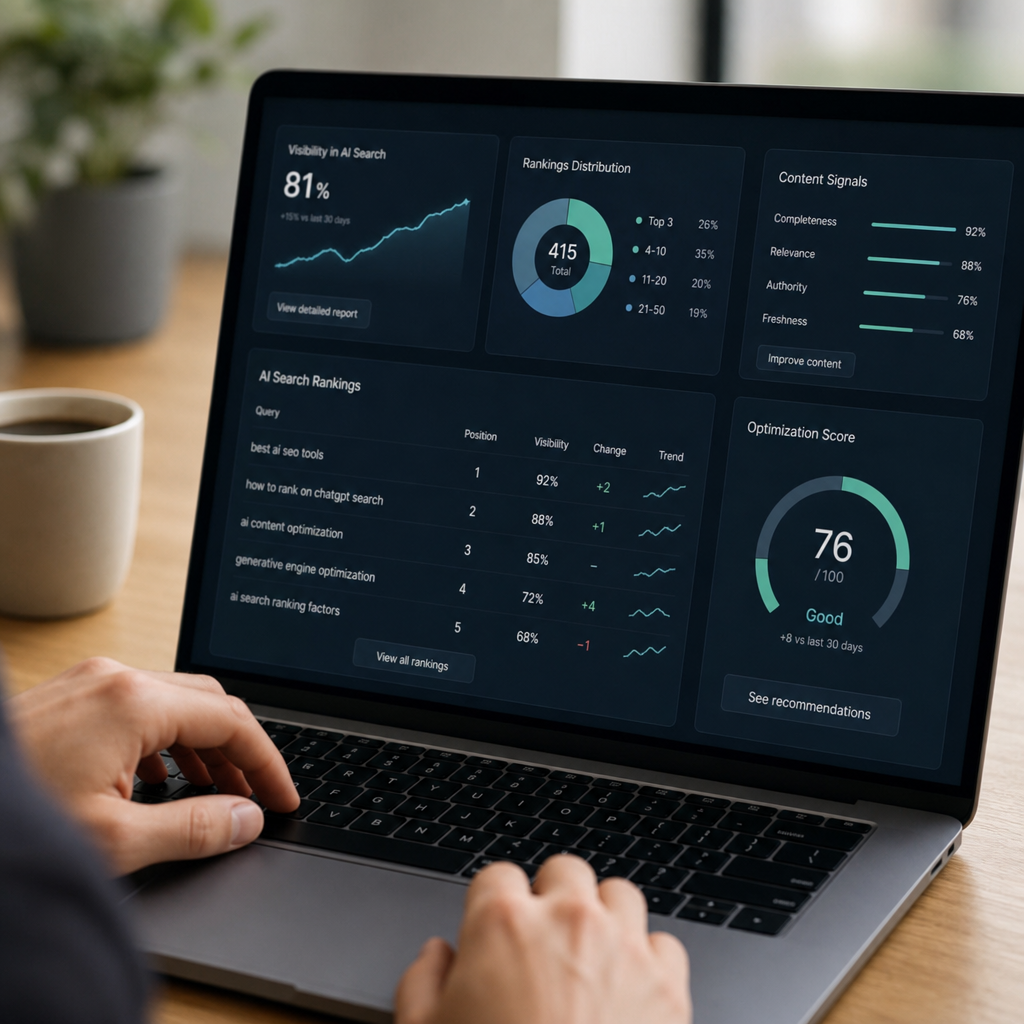
- Citation frequency: How often does your brand appear when relevant questions are asked in ChatGPT, Claude, or Gemini?
- Referral traffic from AI platforms: Analytics tools are beginning to segment traffic originating from AI assistant clicks.
- Traditional organic rankings: Since GEO and SEO overlap significantly, Google Search Console remains a valuable data source.
- Backlink growth: Monitor new referring domains as a proxy for authority building.
- Content freshness cadence: Track how often cornerstone pages are updated relative to competitors.
Combining these metrics gives a clearer picture of whether your AI search strategy is translating into real business outcomes rather than vanity visibility.
Final Thoughts
Learning how to rank on ChatGPT search isn't about gaming an algorithm — it's about producing genuinely authoritative, well-structured, and consistently updated content while ensuring your site is technically accessible to AI crawlers. The businesses that treat this as an ongoing discipline, rather than a one-time project, will be the ones cited, recommended, and trusted by AI assistants for years to come.
Doing this manually at scale is difficult, which is why platforms like FrontRank exist — automating content calendars, keyword research, daily publishing, and AI crawlability audits so businesses can focus on running their operations instead of chasing an ever-shifting search landscape. Whether you're a solo founder, a growing eCommerce brand, or an agency managing multiple clients, FrontRank offers a practical path to staying visible across both Google and the AI assistants shaping how customers discover businesses today.
Article written by FrontRank