
Most business websites have a blog tab that leads to a graveyard. Three posts from 2022, one from last spring, and a stale "Welcome to our new website" entry that was never deleted. If you've landed here searching for how to turn my website into a blog machine, you already know the problem isn't ambition — it's throughput. You don't need one good article. You need a system that keeps producing good articles, on schedule, forever, without becoming your full-time job.
This article breaks down exactly what that system looks like in 2026: the publishing cadence that actually moves rankings, what it costs to build versus outsource versus automate, and the specific mechanics of turning a dormant CMS into a self-sustaining content engine.
Why "Just Post More Often" Isn't the Whole Answer
There's a persistent myth that blogging success is purely a volume game — post daily and Google rewards you. Volume matters, but only when paired with structure. A blog machine isn't a firehose of random posts; it's a coordinated system with four moving parts working together:
- Keyword research that identifies what your actual customers are typing into Google and AI assistants
- A content calendar that sequences those keywords logically instead of randomly
- Writing that matches search intent, reads naturally, and meets a quality bar
- Publishing infrastructure that gets the piece live on your CMS without manual copy-paste
Most businesses that try to "blog more" solve for only one of these — usually writing — and the system collapses within two months because nobody has time to keep feeding it. HubSpot's own research on content marketing consistently shows that companies publishing on a steady cadence outperform sporadic publishers by a wide margin, but cadence requires infrastructure, not just willpower.
The Real Cost of Each Blogging Path
Before you decide how to turn your website into a blog machine, it helps to see the actual cost structure side by side. Business owners usually evaluate three paths: hire in-house, hire an agency, or automate with software.
| Approach | Monthly Cost | Posts/Month | Time Required From You | Consistency Risk |
|---|---|---|---|---|
| In-house writer (part-time) | $2,000–$4,000 | 8–12 | Hiring, managing, editing | High (turnover, sick days, burnout) |
| Freelance writers (per-article) | $150–$500/article | Varies by budget | Briefing, editing, publishing | Medium (quality variance) |
| SEO/content agency retainer | $1,500–$6,000+ | 4–8 | Approvals, feedback rounds | Medium (agency churn, generic output) |
| Automated publishing platform (e.g. FrontRank) | $100–$400 | 20–30+ | Near zero after setup | Low (runs on a fixed schedule) |
The numbers above are directional, but the pattern holds across almost every small business and agency conversation: the more human hands touch each article, the more expensive and fragile the pipeline becomes. A single freelance writer getting sick for two weeks can quietly erase a quarter's worth of publishing cadence. An agency losing your account manager often means a month of ramp-up with a replacement who doesn't know your brand voice yet.
What "Blog Machine" Actually Means in Practice
A blog machine is not a metaphor for "lots of content." It's a specific operational setup where new articles appear on your site automatically, on a schedule, without someone manually deciding, writing, formatting, and uploading each one. Three characteristics define it:
- Predictability — you know a new article will publish every day or every few days, regardless of whether you personally had time this week
- Topical coverage — the articles aren't random; they systematically work through the keywords your customers actually search
- Zero manual publishing steps — no copying text from a Google Doc into WordPress, no formatting headers, no uploading images one at a time
This is the gap most "content strategies" fail to close. A strategy document that says "publish twice a week" isn't a machine — it's a hope. Search Engine Journal has covered extensively how publishing consistency, not just quality, correlates with organic growth, because Google's crawlers and ranking systems reward sites that demonstrate ongoing topical authority rather than a single burst of content followed by silence.
Step-by-Step: Building the Machine Yourself
If you want to attempt this manually before automating it, here's the realistic sequence small business owners and agencies go through:
- Audit your existing content. Identify what's already published, what's ranking, and what's outdated or thin.
- Build a keyword list. Use a tool like Google Search Console to see what you already rank for on page two or three — those are your fastest wins.
- Cluster keywords into topics. Group related searches so each article supports a few neighboring terms instead of competing with your own future posts.
- Create a publishing calendar. Assign dates, not just topics. A calendar without dates is just a list.
- Write or commission the articles. Match search intent — informational, commercial, or transactional — to the right format.
- Format and publish consistently. Headers, internal links, meta descriptions, and images need to be applied the same way every time.
- Track rankings and iterate. Pull data monthly and adjust the keyword list based on what's actually gaining traction.
Doing this manually for one or two months is very achievable. Doing it for twelve consecutive months, across every week including the ones where you're dealing with payroll, inventory, or client fires, is where almost every DIY attempt quietly dies. The bottleneck is never the strategy. It's the sustained execution.
Where Most DIY Attempts Break Down
Talk to any small business owner who tried to run their own blog for a year and the same failure points come up repeatedly:
- Keyword research stalls. After the first 15–20 obvious topics, finding new angles gets harder and takes real research time.
- Writing becomes a bottleneck. Even a confident writer struggles to produce 1,500+ words of genuinely useful content multiple times a week while running a business.
- Formatting and uploading get skipped. Articles sit in a Google Doc for three weeks because nobody has twenty minutes to format and publish them.
- The calendar drifts, then disappears. Without someone accountable for the schedule, "weekly" becomes "whenever," and whenever becomes "never again."
- Quality becomes inconsistent. Different writers, different moods, different days — the voice and quality bar swings wildly.
This is precisely the gap that automated publishing platforms were built to close. Ahrefs' blogging statistics research has shown that the sites seeing the strongest compounding organic traffic gains are the ones maintaining steady output over many months — not the ones that published aggressively for six weeks and stopped.
Automation vs. Manual: A Direct Comparison
Here's how the two paths compare across the factors that actually matter to a business owner deciding how to turn their website into a blog machine.
| Factor | Manual / DIY Blogging | Automated Platform |
|---|---|---|
| Setup time | Days to weeks (research, hiring, templates) | Minutes (connect CMS) |
| Ongoing time commitment | 5–15 hours/week | Near zero |
| Publishing cadence | Inconsistent, dependent on available time | Fixed daily/weekly schedule |
| Keyword strategy | Manual, requires ongoing research | Generated and refreshed automatically |
| Cost predictability | Variable (freelancer rates fluctuate) | Fixed monthly fee |
| Scalability across multiple sites | Difficult without hiring more people | Built for multi-site management |
| Risk of abandonment | High | Low — runs regardless of your schedule |
For a single founder running one site, this might be a close call. For a digital agency managing content across ten or twenty client sites, the manual column becomes functionally impossible without a large content team — which is exactly why so many agencies have started layering automated publishing into their service stack rather than hiring additional writers for every new client.
How FrontRank Builds the Machine for You
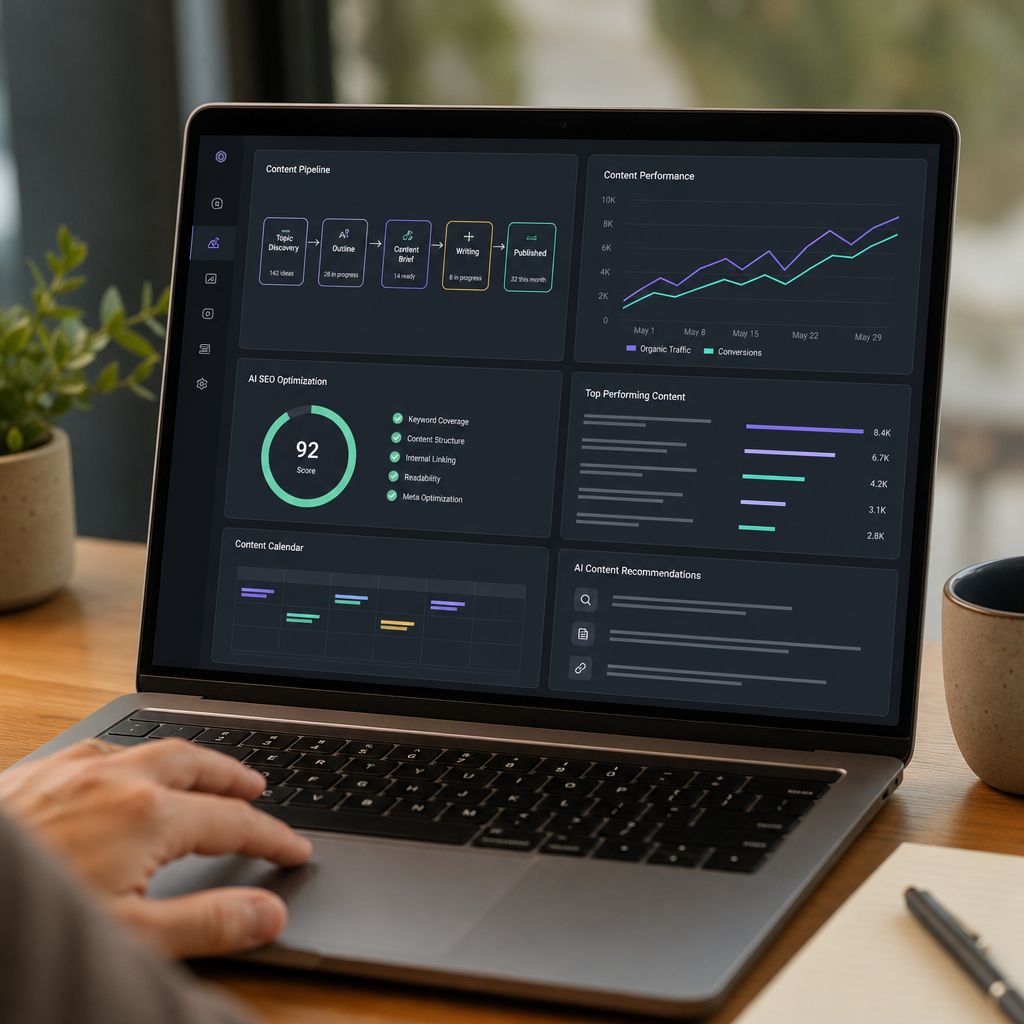
This is where frontrank.com fits into the picture. Instead of treating blog machine as an aspiration you build piece by piece, FrontRank is built specifically to be the machine — the entire pipeline from keyword to published article runs without you touching a document or a CMS dashboard.
Here's the mechanical flow:
- One-click CMS connection. Whether you're on WordPress, Webflow, Wix, Shopify, Ghost, or Framer, you connect your site in a single click — no API keys, no developer, no plugin configuration.
- Automatic keyword generation. The system identifies relevant keywords for your niche and audience, the same strategic step most businesses skip or half-finish.
- Content calendar built automatically. Topics are sequenced logically so each article supports your overall topical authority instead of existing in isolation.
- Articles written to a quality bar. Each piece is structured for both traditional search engines and the AI assistants (like ChatGPT, Perplexity, and Gemini) that increasingly answer questions by citing well-structured web content.
- Direct publishing, no copy-paste. Finished articles appear live on your CMS automatically, on the schedule you've set — daily, every few days, or weekly.
The entire value proposition of FrontRank is removing every single manual step between "we should write a blog post about this" and "the blog post is live and indexed." For a small business owner, that means getting the SEO benefit of a disciplined content program without becoming an accidental part-time content manager. For an agency, it means offering blog content as a service across every client site without needing to staff up a writing team.

Why AI Visibility Changes the Blogging Calculation
Something has shifted since the earlier years of content marketing: ranking in Google is no longer the only prize. AI assistants like ChatGPT, Perplexity, and Google's AI Overviews now answer millions of queries daily by citing and summarizing web content directly. This emerging discipline is often called GEO — Generative Engine Optimization — and it runs on the same underlying asset as traditional SEO: a steady supply of well-structured, specific, genuinely useful articles.
Sites with thin or stagnant blogs are largely invisible to both systems. Sites that publish consistently, cover their niche thoroughly, and structure content clearly are the ones getting pulled into AI-generated answers as cited sources. Moz's guide to technical SEO fundamentals reinforces how structure and consistency compound over time — the same principle now applies to being cited by generative engines, not just ranked by traditional search.
This is precisely why the "blog machine" concept matters more in 2026 than it did five years ago. It's not just about traffic from blue links anymore — it's about becoming the source material that AI systems trust enough to quote.
Signs Your Website Is Ready for This
Not every business needs to flip the switch immediately, but certain signals suggest the time is now:
- Your blog hasn't been updated in more than 60 days
- You're relying entirely on paid ads because organic traffic is flat or declining
- Competitors with weaker products are outranking you simply because they publish more consistently
- You've tried hiring a writer or freelancer before and the arrangement fizzled out
- You manage multiple client or brand websites and can't justify a writer for each one
- You've noticed ChatGPT or Perplexity citing competitors but never your site
If two or more of these sound familiar, the manual approach has likely already been tested and found wanting — which makes an automated pipeline the more realistic next step rather than trying the same manual approach with slightly more discipline.
Common Questions Business Owners Ask Before Starting
Will the content sound robotic? Modern automated publishing tools are built specifically to avoid generic, templated output — the writing is structured around real search intent and specific detail, not keyword-stuffed filler.
Do I need to approve every article before it goes live? Depending on the platform and your preference, you can review before publishing or let the schedule run fully automatically once you trust the output quality.
What if I already have some blog posts? A functioning system audits what exists and builds forward from there rather than starting from zero or duplicating old topics.
Can this work for multiple websites under one account? Yes — this is specifically why agencies managing several client sites have moved toward centralized, automated publishing rather than assigning a writer per client.
How fast will I see ranking movement? Realistically, meaningful organic movement takes a few months of consistent publishing, since search engines reward sustained signal over single bursts.
Bringing It All Together
Turning your website into a blog machine isn't about finding more hours in your week or finally hiring the right freelancer — it's about removing the dependency on hours and freelancers entirely. The businesses seeing compounding organic growth in 2026 are the ones that treated blogging as infrastructure, not as a task on someone's to-do list.
Whether you choose to build this manually, piece by piece, or adopt a platform that already does it end-to-end, the core requirement is the same: consistent, strategic, well-structured publishing that never stops because someone got busy. frontrank.com was built around exactly that principle — connect your CMS once, and let the keyword research, content calendar, writing, and publishing run on autopilot, so your site keeps growing whether or not this week was a busy one. If you're ready to stop treating your blog like a side project and start treating it like infrastructure, that's the shift FrontRank exists to make simple.
Article written by FrontRank