
Search behavior has changed more in the last two years than in the previous decade. Millions of people now ask ChatGPT, Gemini, Claude, and Perplexity for recommendations instead of typing queries into a traditional search bar. If your business isn't showing up in those answers, you're invisible to a rapidly growing segment of your audience. Learning how to rank in AI search results is no longer optional — it's becoming as fundamental as traditional SEO was a decade ago.
This guide breaks down exactly how AI search engines work, what separates content that gets cited from content that gets ignored, and how to build a repeatable system for AI search visibility.
What Does It Mean to Rank in AI Search Results?
Ranking in AI search results means your brand, product, or content gets referenced, summarized, or linked to when an AI assistant answers a user's question. Unlike traditional search engine results pages (SERPs), AI search doesn't show ten blue links — it generates a synthesized answer, often citing three to five sources.
This shift has given rise to a new discipline: Generative Engine Optimization (GEO). While traditional SEO focuses on keyword rankings and backlinks, GEO focuses on structuring content so large language models (LLMs) can easily extract, understand, and cite it. According to research from Princeton and Georgia Tech on generative engine optimization, content that includes clear statistics, direct quotations, and well-structured sections is significantly more likely to be cited by generative engines.
The core difference between traditional SEO and GEO comes down to what's being optimized for:
| Factor | Traditional SEO | GEO (AI Search Optimization) |
|---|---|---|
| Goal | Rank on page 1 of Google | Get cited inside an AI-generated answer |
| Primary signal | Backlinks + keyword relevance | Content clarity, structure, and citations |
| Content format | Long-form, keyword-optimized | Structured, scannable, fact-dense |
| User outcome | Click to website | Brand mention with or without a click |
| Update frequency | Periodic content refreshes | Continuous publishing and freshness signals |
How AI Search Engines Actually Choose Sources
AI assistants don't crawl the web in real time for every query. Instead, they rely on a combination of pre-trained knowledge and live retrieval systems (often called RAG, or retrieval-augmented generation) that pull from indexed web content, structured data, and trusted domains.
Here's a simplified breakdown of how most AI search tools decide what to cite:
- Query interpretation — the AI parses intent and breaks the question into sub-topics.
- Retrieval — it searches an index (sometimes powered by Bing, Google, or its own crawler) for relevant, authoritative pages.
- Relevance scoring — pages are scored based on topical match, freshness, structure, and trust signals like domain authority and citations elsewhere.
- Synthesis — the model generates an answer, pulling short excerpts or facts from the top-scoring sources.
- Citation — depending on the platform, sources are shown as footnotes, links, or brand mentions.
Google's own documentation on how AI Overviews are generated confirms that pages need strong foundational SEO — crawlability, structured data, and clear content hierarchy — before they're even eligible for AI-generated summaries. In other words, GEO doesn't replace SEO; it builds on top of it.
This is exactly the gap that a platform like FrontRank is built to close — combining traditional SEO fundamentals with AI-specific optimization so businesses show up in both worlds simultaneously.
Why Traditional SEO Alone Isn't Enough Anymore
Many businesses still treat SEO as a Google-only game. That mindset is quickly becoming outdated. Consider the shift in how information is consumed:
- Zero-click searches are rising as AI Overviews and chat-based answers satisfy queries directly.
- Younger users increasingly start research in ChatGPT or Perplexity instead of Google.
- Voice assistants and AI browser extensions pull answers from AI models rather than search rankings.
- B2B buyers are using AI tools to shortlist vendors before ever visiting a website.
A Search Engine Land report on AI search adoption has repeatedly highlighted that AI-generated answers are changing click-through behavior across industries, particularly in eCommerce, SaaS, and local services. If your content strategy only targets Google's traditional algorithm, you're optimizing for a shrinking slice of total search behavior.
That doesn't mean SEO is dead — quite the opposite. Google itself uses many of the same signals (content structure, authority, freshness) to power its AI Overviews. The businesses winning in this new landscape are the ones optimizing for both simultaneously.
The Core Pillars of Ranking in AI Search Results
To consistently show up in AI-generated answers, your content and site need to satisfy several overlapping requirements. Below are the six pillars that matter most.
1. Crawlability and Technical Access
AI crawlers — including GPTBot, Google-Extended, and ClaudeBot — need unrestricted access to your content. Many sites unintentionally block these crawlers through outdated robots.txt rules or JavaScript-heavy rendering that hides content from bots.
2. Structured, Extractable Content
LLMs favor content that's easy to parse: clear headings, bullet points, definitions, and direct answers near the top of a section. Walls of unstructured text are harder for models to extract and cite accurately.
3. Topical Authority
Publishing one great article rarely earns citations. AI models favor domains that demonstrate consistent depth on a topic — multiple interlinked articles covering a subject from different angles.
4. Freshness and Publishing Frequency
Generative engines weigh recency heavily, especially for evolving topics. Sites that publish consistently signal ongoing relevance, while stagnant sites fall out of the citation pool over time.
5. Backlinks and Third-Party Mentions
Just like traditional SEO, being mentioned and linked to by other reputable sites boosts your credibility in the eyes of both search engines and AI retrieval systems.
6. Clear Entity and Brand Signals
AI models need to understand who you are. Consistent naming, structured data (schema.org markup), and clear "About" information help models correctly attribute facts to your brand instead of a competitor.
Step-by-Step: Building an AI Search Optimization Strategy
Here's a practical roadmap for improving your visibility in both AI search results and traditional rankings.
- Audit your site for AI crawlability. Check robots.txt, server logs, and rendering behavior to confirm AI crawlers can access your key pages.
- Map your topic clusters. Identify the core questions your audience asks and organize content around pillar topics rather than isolated keywords.
- Publish consistently. Aim for a steady cadence of new, well-researched articles rather than sporadic bursts of content.
- Structure every article for extraction. Use descriptive headers, short paragraphs, bullet lists, and direct answers to common questions.
- Earn backlinks through partnerships and guest content. Sites like leadmailbox.com regularly publish resources that link out to relevant tools and services — building relationships with content-driven sites like this strengthens your authority footprint.
- Add structured data markup. Implement schema for articles, FAQs, products, and organizations to help both search engines and AI systems parse your content correctly.
- Monitor citations. Regularly check whether ChatGPT, Gemini, and Perplexity mention your brand, and refine content based on what gets cited versus ignored.
This is precisely the workflow that FrontRank automates — from technical crawlability audits to daily content publishing — removing the manual guesswork that most teams don't have time for.
Comparing Manual SEO vs. AI-Automated Optimization
Businesses generally take one of three paths to improve their search and AI visibility: doing it manually in-house, hiring an agency, or using an automation platform. Each comes with tradeoffs.
| Approach | Time Investment | Typical Cost | Consistency | AI Search Readiness |
|---|---|---|---|---|
| In-house manual SEO | High (10-20+ hrs/week) | Salary + tools | Often inconsistent | Requires specialized GEO knowledge |
| Traditional SEO agency | Low for client, high for agency | $1,500–$10,000+/month | Depends on contract | Varies widely by agency expertise |
| AI automation platform (e.g., FrontRank) | Very low | Predictable subscription | Daily, automated | Built-in from the ground up |
The biggest differentiator isn't just cost — it's consistency. AI search engines reward domains that publish fresh, well-structured content regularly. Most in-house teams and even agencies struggle to maintain a daily or near-daily publishing cadence indefinitely. Automation closes that gap without sacrificing quality, provided the underlying system is built with SEO and GEO best practices baked in.
Common Mistakes That Keep Businesses Out of AI Answers
Even well-intentioned content strategies often fail to earn AI citations. Here are the most frequent mistakes:
- Blocking AI crawlers accidentally. Overly restrictive robots.txt files or bot-management tools can block GPTBot, ClaudeBot, and similar crawlers without anyone noticing.
- Publishing thin or generic content. AI models favor specific, well-sourced information over vague marketing copy.
- Ignoring structured data. Without schema markup, AI systems have to infer context that could otherwise be explicitly defined.
- Inconsistent publishing schedules. Long gaps between updates signal declining relevance.
- No internal linking strategy. Poorly linked content makes it harder for both crawlers and AI retrieval systems to understand topical relationships across your site.
- Overlooking E-E-A-T signals. Experience, Expertise, Authoritativeness, and Trustworthiness — a framework detailed in Google's Search Quality Rater Guidelines — remain central to how both Google and AI models evaluate credibility.
Avoiding these pitfalls is often more impactful than chasing every new tactic. A technically sound, consistently updated site with clear expertise signals will outperform a flashier but inconsistent competitor almost every time.

How FrontRank Automates AI Search Visibility
Manually executing everything covered in this guide — technical audits, keyword research, content calendars, daily publishing, and backlink building — is a full-time job, and most founders, marketers, and agencies simply don't have the bandwidth.
FrontRank was built specifically to solve this problem. The platform combines several critical functions into a single automated workflow:
- AI crawlability audits that identify technical barriers preventing GPTBot, ClaudeBot, and Google-Extended from accessing your site.
- AI-generated content calendars built around real search demand and topic gaps in your niche.
- Automated keyword and topic research that continuously adapts based on performance data.
- Daily publishing of SEO- and GEO-optimized articles, each structured for both human readers and AI extraction.
- Backlink placement to strengthen domain authority and third-party validation signals.
Instead of treating AI search optimization as a one-time project, frontrank.com treats it as an ongoing system — because that's exactly how AI models and search engines evaluate relevance: continuously, not periodically.
Measuring Success: What Metrics Actually Matter
Ranking in AI search results requires new ways of measuring success beyond traditional keyword rank tracking. Consider monitoring:
| Metric | What It Tells You |
|---|---|
| AI citation frequency | How often your brand appears in ChatGPT, Gemini, or Perplexity answers for target queries |
| Referral traffic from AI platforms | Direct evidence of AI-driven visibility converting into site visits |
| Organic keyword rankings | Traditional SEO health, which underpins AI retrieval eligibility |
| Backlink growth | Authority signals that influence both SEO and GEO performance |
| Content publishing velocity | Consistency, a key freshness signal for AI systems |
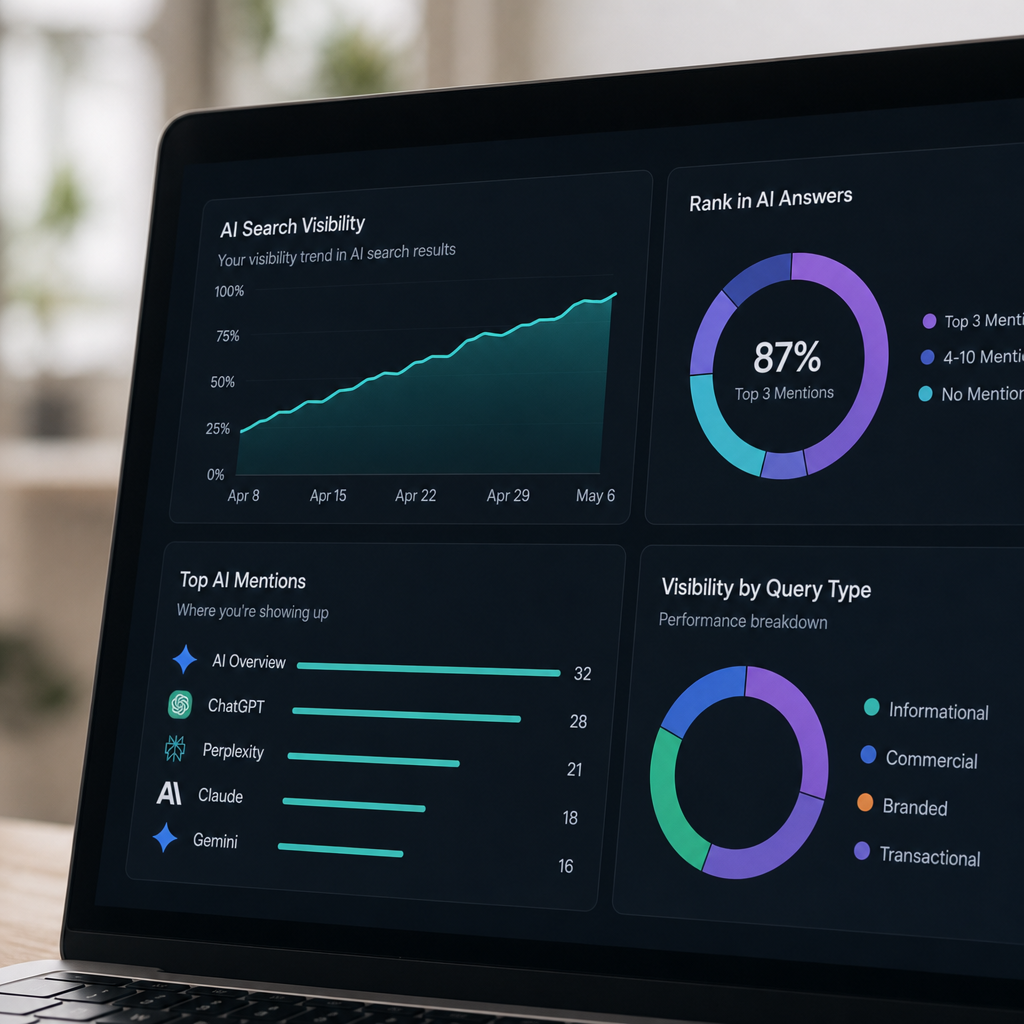
Tools are emerging specifically to track AI citations, but even manually testing your target queries across multiple AI assistants each month provides valuable directional insight into whether your optimization efforts are working.
Final Thoughts
Ranking in AI search results isn't a separate discipline from SEO — it's the natural evolution of it. The businesses that win in this new landscape will be the ones that combine strong technical foundations, consistent high-quality publishing, and content structured for both human readers and machine extraction.
Trying to manage all of this manually is time-consuming and easy to get wrong, which is why more founders, marketers, and agencies are turning to automated platforms. FrontRank exists to make AI search visibility achievable without hiring a full content and SEO team — automating everything from technical audits to daily publishing so your business shows up wherever your customers are searching, whether that's Google or the next AI assistant they open.
Article written by FrontRank