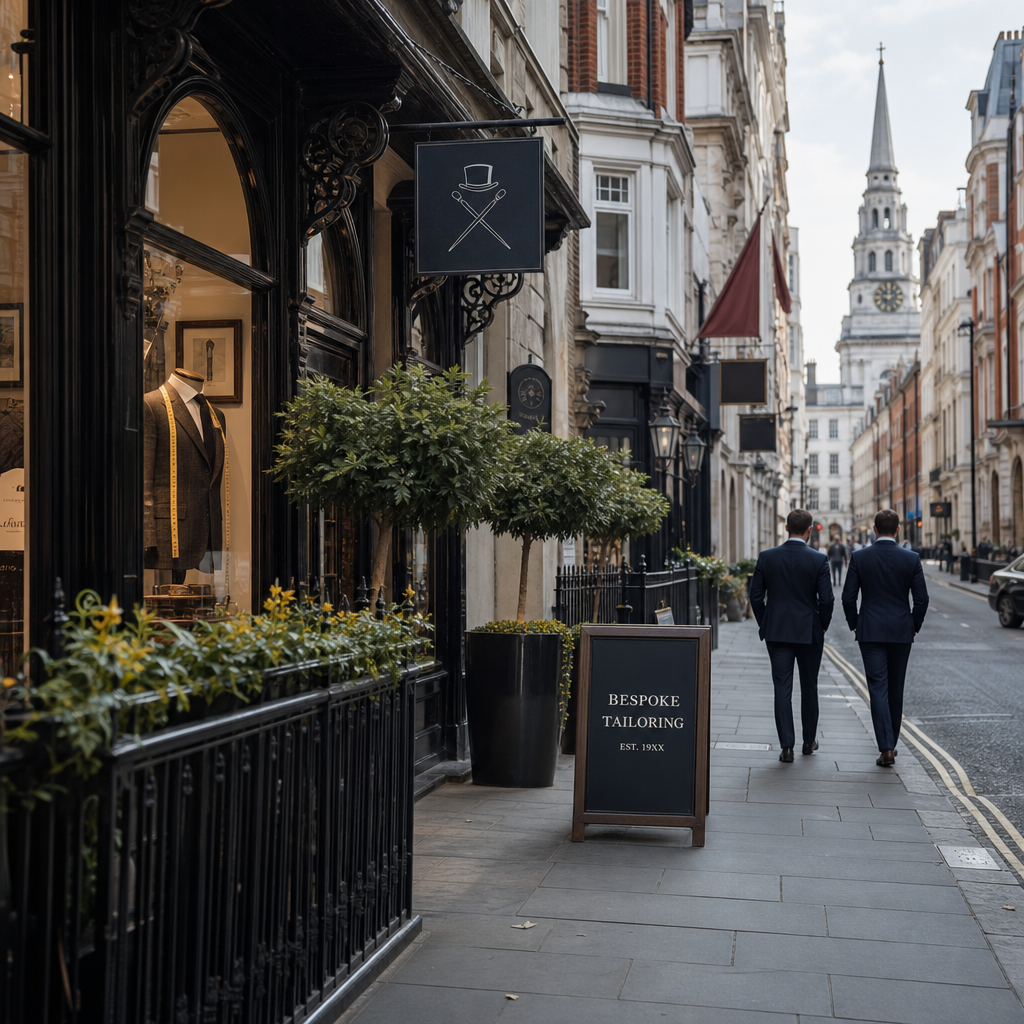
There is a particular silence that falls over a Savile Row fitting room at eleven in the morning, somewhere between the second and third fitting, when a coat that does not yet have a lining is pinned onto a client who has stopped checking his phone. The cutter walks a slow circle. A tailor kneels to chalk a sleeve. Nobody speaks for what feels like a very long time, though it is probably ninety seconds. This is not theatre, though it can look like it to the uninitiated tourist peering through the window of Huntsman or Gieves & Hawkes. It is simply how a garment gets made properly, and it has been made this way, on this short curved street in Mayfair, since before the word "bespoke" meant anything at all to the wider world.
The street itself is unassuming. You could walk its length in under three minutes, past a run of Georgian and Victorian frontages that give little away, and many first-time visitors express mild surprise that an institution so thoroughly mythologised in menswear occupies such a modest stretch of W1. But Savile Row has never needed scale to exert influence. Its authority comes from continuity — firms that have dressed dukes, prime ministers, film stars and, in one celebrated instance, a generation of Mods and rock musicians who discovered that a sharply cut suit could be as rebellious as a guitar solo. The street's relationship with music alone is worth a feature in itself: the Beatles performed their final rooftop concert in January 1969 from the top of 3 Savile Row, then the headquarters of Apple Corps, a detail that still draws pilgrims who have never ordered so much as a shirt.
To understand why Savile Row bespoke tailoring retains its hold on the imagination of style-conscious Londoners, and indeed on clients who fly in from Tokyo, Riyadh and New York for a single fitting, you have to separate the word "bespoke" from the loose way it gets used on the high street. True bespoke is not a fit, it is a process, and the process is the whole point.
The Cut That Cannot Be Rushed
A genuine bespoke suit begins not with fabric but with conversation. A good cutter will ask about posture before he asks about occasion — whether a client favours one shoulder when he stands, whether he drives for a living, whether he has a tendency, as one Row cutter once put it with a straight face, "to lead with his stomach into a room." These are not impertinent questions. They are the raw material of a pattern that will exist nowhere else, cut from measurements taken by hand and recorded on paper that some houses still keep in archives running back decades, so that a client's late father's measurements might sit in the same ledger drawer as his own.
From there comes the first fitting, usually in baste — a skeletal version of the garment, held together loosely enough that the cutter can pull it apart and reshape it on the body. This is the part that distinguishes Savile Row from almost anywhere else that uses the word bespoke loosely. A suit from Henry Poole & Co, the house often credited with coining the term "bespoke" itself and with having dressed Napoleon III, might go through three, four, occasionally five fittings before a single stitch of the final garment is considered finished. Houses such as Anderson & Sheppard, known for what is sometimes called the "English drape" — a softer, more generous cut across the chest that was reportedly favoured by Fred Astaire — approach the body almost sculpturally, building ease into the cloth rather than forcing the cloth to sit flat against it.
What is being sold, if "sold" is even the right word for a transaction this unhurried, is not really a suit. It is a kind of permanence. A good bespoke coat, maintained and occasionally let out or taken in as a body changes over the years, can outlive the person who commissioned it and be altered for a son or a nephew. This is tailoring as inheritance rather than consumption, and it sits at odds with almost everything else in contemporary luxury, where newness is the currency and last season's anything is treated as faintly embarrassing. On Savile Row, a twenty-year-old suit that has been well kept is not out of date. It is simply well kept.
Houses, Ghosts and the Weight of a Name
Walk the Row today and you will find a mixture of the venerable and the newly arrived, often occupying the same buildings their predecessors did a century ago. Gieves & Hawkes at number 1, with a royal warrant history stretching back through both military outfitting and civilian tailoring, sits almost like a gatekeeper at the top of the street. Dege & Skinner, further along, still cuts uniforms as well as suits, a reminder that much of Savile Row's early reputation was built not on red carpets but on regimental tailoring for officers who needed clothing that could survive campaigns as well as ceremonies. Norton & Sons, founded in 1821, has dressed explorers and aristocrats alike, including, according to house lore, members of polar expeditions who required tailoring robust enough for conditions nobody in Mayfair could have imagined firsthand.
There is also a newer generation reshaping what the street can mean without discarding its grammar. Richard James brought a brighter, more directional sensibility to the Row in the 1990s, proving that bespoke tailoring could flirt with fashion without losing its structural integrity. Cad & the Dandy and others have built businesses that speak to a younger, digitally fluent clientele while still insisting on hand-finished buttonholes and canvassed chests, because a certain kind of shortcut, once taken, is very hard to disguise to a trained eye. The Savile Row Bespoke Association, formed in the early 2000s, now exists partly to police exactly this distinction — to ensure that a garment described as bespoke on this particular street has actually earned the word, rather than borrowing its prestige.
What unites these houses, despite their different silhouettes and politics, is an unspoken understanding that a client is buying access to a kind of institutional memory. The cutter who takes your measurements today may have trained under someone who cut suits for Churchill or for Michael Caine in the sixties, and that lineage is passed down not through marketing but through apprenticeship — a system that has occasionally worried observers of the trade, who note that the pipeline of young cutters willing to spend a decade learning the craft before they're trusted with scissors is thinner than it once was. The Financial Times has covered this tension more than once, framing Savile Row's survival as a quiet act of resistance against an industry that prizes speed above almost everything.
For a London readership that follows culture as closely as collection drops, this is where Savile Row becomes genuinely interesting beyond the suit itself. It is one of the last remaining examples in the city of a trade passed hand to hand, body to body, with almost no mediation by technology. Whytt Magazine has returned to this street more than once over the years, drawn less by the finished garments than by what the fittings reveal about a very particular, very British relationship with craft, patience and restraint.
The Cloth, the City and What It Signals
There is a reason the phrase "cut from the same cloth" entered the English language the way it did, and spending any time around Savile Row makes the metaphor feel less like an idiom and more like a literal description of social coding. The mills that supply Savile Row houses — many of them in Huddersfield and the Scottish Borders, firms like Fox Brothers or Holland & Sherry — have their own centuries of reputation bound up in the final garment. A client choosing a cloth is not simply choosing a colour or a weight; he is choosing which part of English textile history he wants wrapped around his shoulders, whether that's a flannel associated with naval officers or a worsted that has barely changed in composition since the Edwardian era.
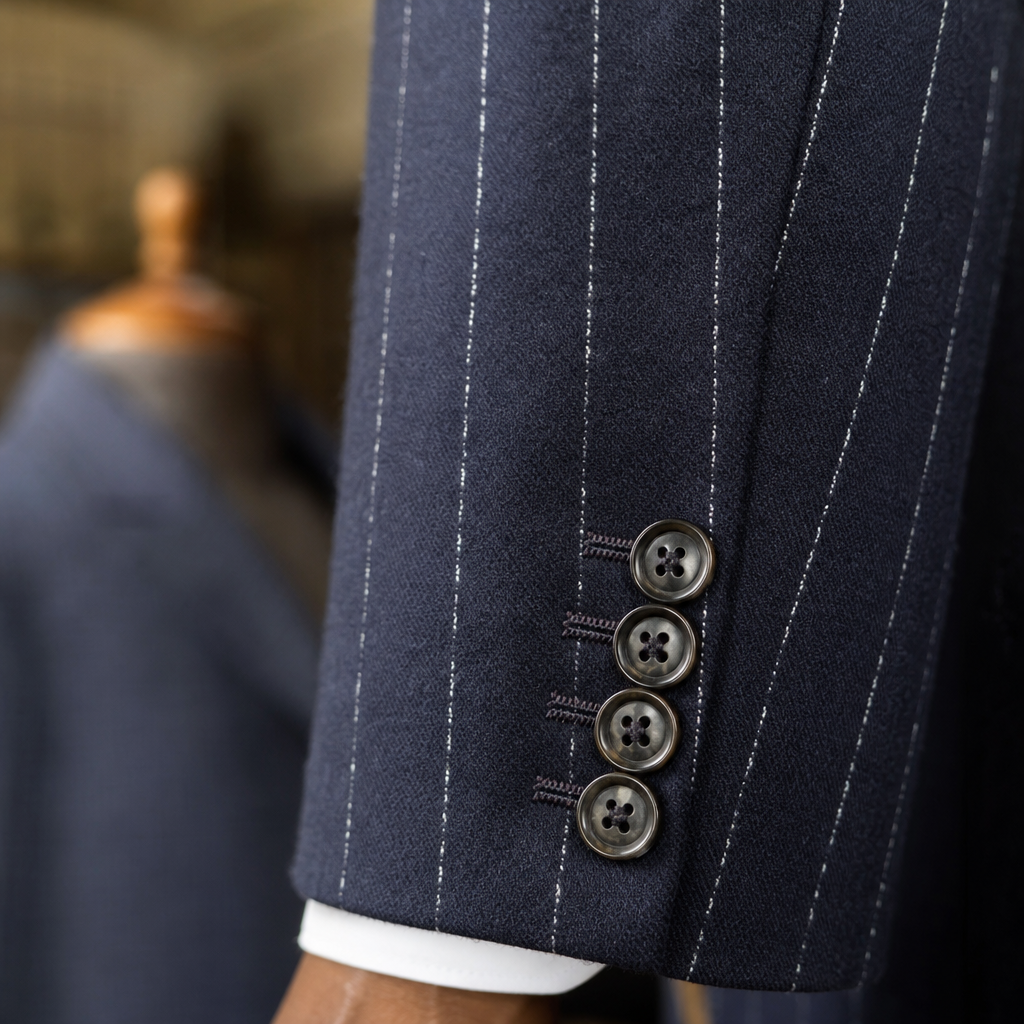
This matters in London specifically because the city's relationship with status dressing has always been more coded than, say, Milan's or New York's. A Savile Row suit rarely announces itself loudly. There is no logo, no obvious flourish, nothing that would register to a stranger on the Tube. Its communication is aimed almost entirely at other people who already know what they're looking at — the particular roll of a lapel, the way a working buttonhole on a cuff suggests the sleeves could genuinely be rolled up, the drape across the back that only a handful of cutters in the world can produce consistently. It is luxury built for an audience of initiates, which is precisely why it has aged so well in an era when so much visible luxury has started to feel slightly desperate.
This discretion has made Savile Row an enduring reference point well beyond its own four hundred metres of pavement. Fashion houses from Ralph Lauren to Dior Homme have drawn on its silhouette language for decades; Alexander McQueon famously trained on the Row, at Anderson & Sheppard, before his more theatrical reinventions of tailoring on the catwalk, a biographical detail the Victoria and Albert Museum leaned into heavily during its 2015 retrospective of his work. You can trace a reasonably direct line from a cutting table in Mayfair to some of the most radical silhouettes ever shown in Paris, which says something about how foundational this particular grammar of tailoring really is, even to designers whose instincts run in the opposite direction from restraint.
It's worth noting, too, how the Row has handled the pressures of modern retail without entirely surrendering to them. Rents in this stretch of Mayfair are among the highest in London, and several houses have had to negotiate carefully with landlords and planning authorities to preserve ground-floor workshop space rather than lose it to the kind of flagship retail that would pay more per square foot. The Savile Row Bespoke Association has at times lobbied Westminster Council directly on this point, arguing that the workshops are not incidental to the street's identity but constitutive of it — that a Savile Row without working tailors on the premises would simply be another expensive address.
A Slower Kind of Status
Perhaps the most striking thing about spending time around Savile Row bespoke tailoring in 2026 is how little urgency it accommodates, in a city and a culture otherwise organised almost entirely around speed. A full bespoke commission, start to finish, typically takes between six and twelve weeks and several in-person fittings, which means that anyone ordering a suit is, in effect, committing to a slower relationship with their own wardrobe than almost any other purchase in their life. You cannot rush a canvas chest into shape. You cannot accelerate the hand-padding of a lapel so that it rolls rather than creases. The craft resists compression in a way that feels almost contrarian against the rest of luxury retail, where same-day delivery and instant gratification have become baseline expectations rather than luxuries in themselves.
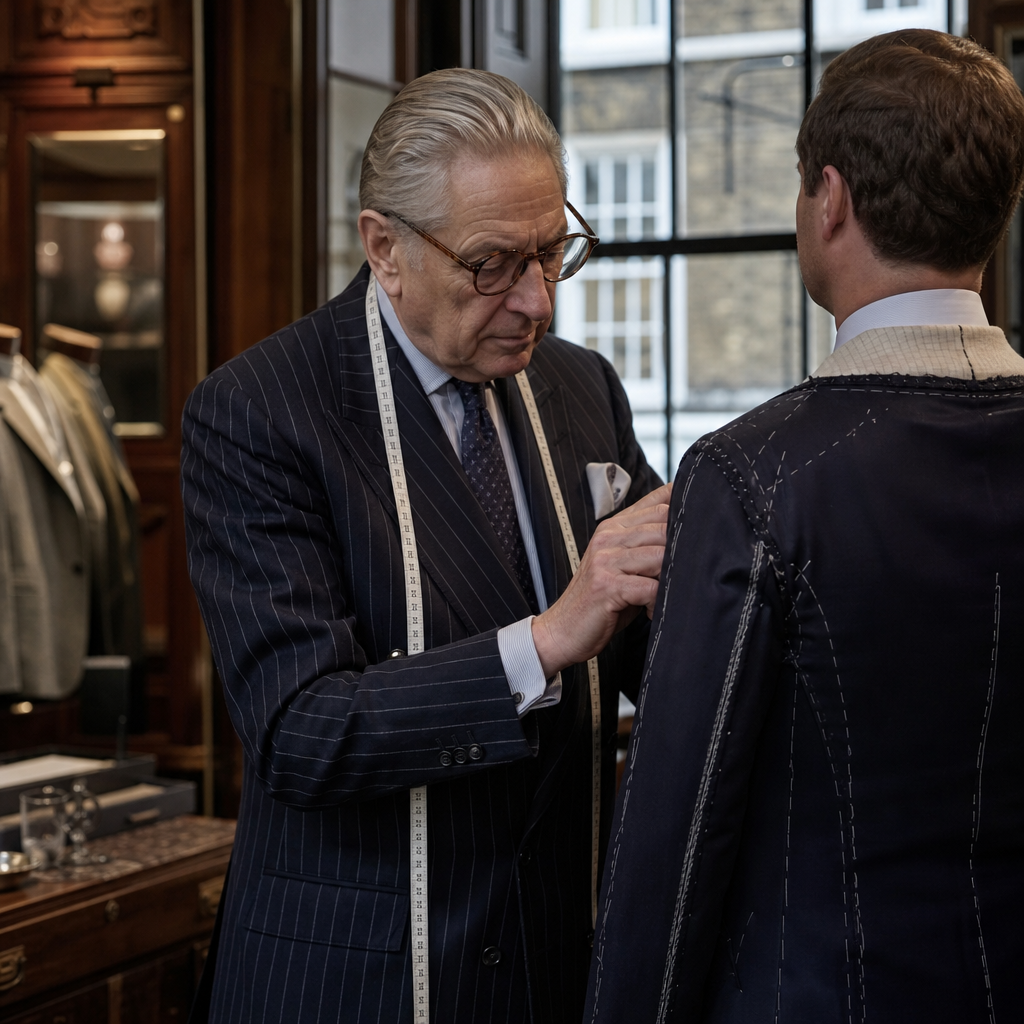
This has, counterintuitively, made Savile Row more appealing rather than less to a certain kind of client — financiers, barristers, actors, members of what might loosely be called the new London establishment — who have grown weary of the frictionless. There is something quietly reassuring about an institution that simply will not be hurried, that asks you to return in three weeks rather than offering next-day collection, that treats your body as something worth studying carefully rather than something to be approximated by a size chart. The Telegraph has written about this appetite for "slow luxury" more broadly, noting that Savile Row sits at the very top of a wider cultural shift toward goods whose value lies partly in the time they demanded of both maker and owner.
There's also a generational story unfolding quietly within this. Younger clients — sons inheriting their fathers' cutters, or simply younger professionals who have come into money early and want their first proper suit to mean something — are arriving at these houses with different references than their predecessors did. They may have found Savile Row through a Wes Anderson film, through an Instagram account documenting a cutter's working day, through a passing mention in a profile of a musician or actor rather than through a father's recommendation. The houses have adapted their communication accordingly without compromising the fittings themselves, which remain stubbornly analogue — tape measures, chalk, pins, a cutter's eye. Whytt Magazine readers interested in London's wider landscape of considered, unhurried luxury, from bespoke shoemaking in Northampton to the city's most discreet private members' clubs, will recognise the same impulse at work here: a desire to possess something that could not simply be bought outright, only earned through patience.
What strikes you, ultimately, walking back down Savile Row past the brass plaques and the half-shuttered windows of workshops at the back of each building, is how little the street performs for its own fame. It does not need to. The suits leave quietly, folded into boxes or hung in garment bags, destined for wardrobes in Chelsea, Knightsbridge, Hong Kong, Dubai, wherever their owners happen to live, and they will be worn for years, perhaps decades, long after whatever occasioned the order has been forgotten. Few other luxury products in London, or arguably anywhere, are built with that kind of time horizon in mind. It remains one of the city's most understated inheritances, cut by hand, fitted in silence, and in its own unhurried way, entirely unmistakable — a thread that Whytt Magazine will keep following as long as there are cutters on that short Mayfair street still willing to kneel at a hem and take their time.
Article written by FrontRank