
Introduction: Why Automated Content Publishing Matters in 2026
Search visibility no longer depends solely on ranking in Google's ten blue links. In 2026, businesses must also be discoverable inside AI-generated answers from ChatGPT, Claude, Gemini, and Perplexity. This dual requirement — traditional SEO plus what's increasingly called Generative Engine Optimization (GEO) — has made manual content production a bottleneck for growth-focused teams.
An automated content publishing tool solves this bottleneck by handling the entire content lifecycle: keyword research, drafting, SEO optimization, formatting, scheduling, and direct publishing to your CMS. Instead of a marketing team manually writing, editing, and uploading articles one by one, an automated system executes this pipeline continuously, often on a daily cadence.
This article explains how automated publishing systems work under the hood, why they matter for both classic search engines and large language models (LLMs), and how to evaluate platforms like frontrank.com against manual workflows and competing tools.
What Is an Automated Content Publishing Tool?
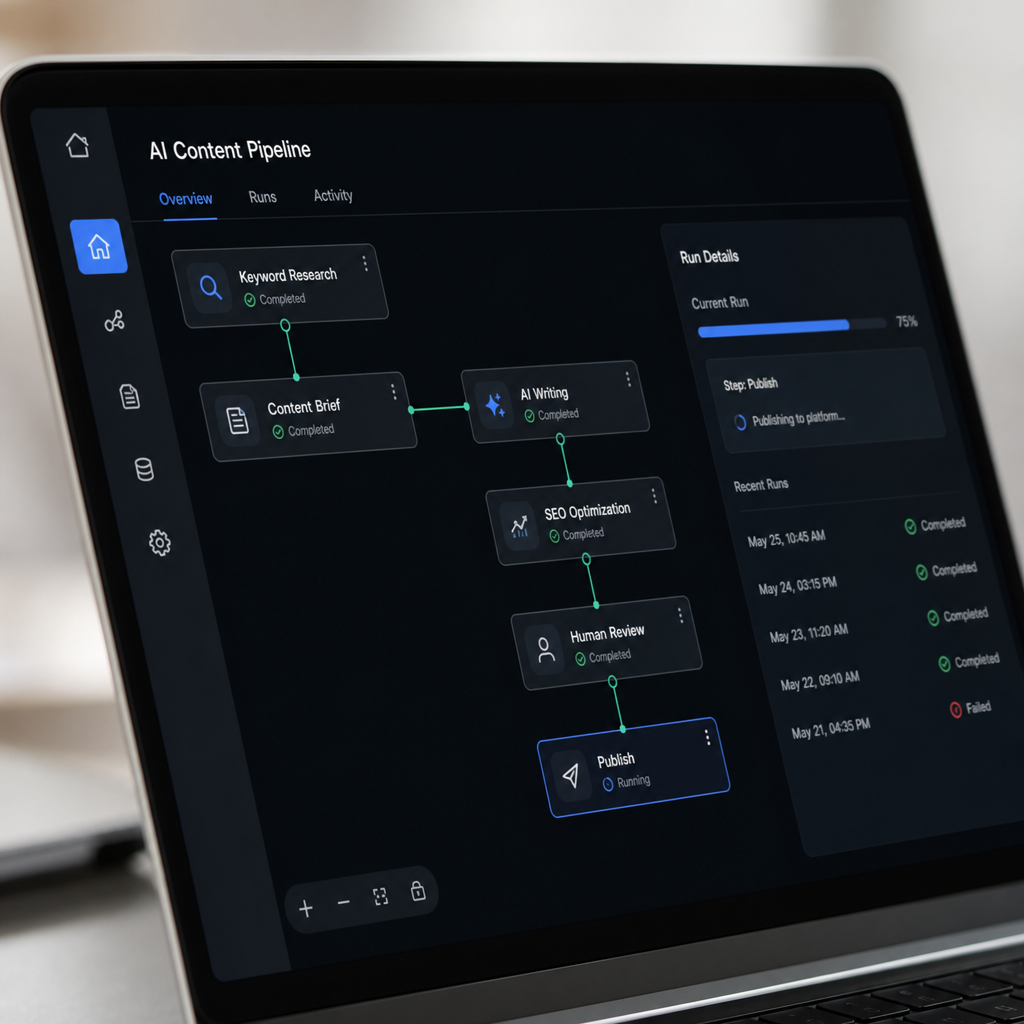
At a technical level, an automated content publishing tool is a software system that combines several discrete functions into a single orchestrated pipeline:
- Keyword and topic discovery — pulling search volume, competition, and intent data from APIs or proprietary datasets.
- Content generation — using large language models to draft articles optimized for both readability and machine parsing.
- On-page SEO structuring — automatically inserting headers, meta descriptions, schema markup, and internal/external links.
- Publishing integration — pushing finished content directly into a CMS such as WordPress, Wix, Webflow, or Shopify via API or plugin.
- Distribution and backlink management — optionally securing backlinks or citations across a network of partner sites to strengthen domain authority.
The distinction between a simple "AI writer" and a true automated publishing tool is important. AI writers generate text; publishing tools generate, structure, schedule, and deploy that text without human intervention. This is the core value proposition behind platforms like FrontRank, which was built specifically to automate the full loop — from keyword research to live, indexed, backlinked articles — rather than stopping at the draft stage.
The Technical Architecture Behind Automated Publishing
Understanding the architecture helps clarify why automation is more reliable and scalable than manual processes. Most modern systems are built around four technical layers:
- Data ingestion layer: aggregates keyword data, SERP data, and competitor content signals.
- Generation layer: leverages LLMs fine-tuned or prompt-engineered for SEO and GEO formatting, including structured headers, FAQ blocks, and citation-friendly phrasing that LLMs like those referenced in OpenAI's documentation can parse and cite accurately.
- Optimization layer: applies on-page SEO rules based on best practices outlined by resources like Google's Search Central documentation and Moz's SEO learning center.
- Deployment layer: connects to CMS APIs for direct publishing, complete with image insertion, internal linking, and metadata population.
This layered approach mirrors how modern DevOps pipelines automate software deployment — except instead of code, the "artifact" being continuously built and shipped is SEO content.
Why AI Visibility (GEO) Changes the Automation Equation
Traditional SEO automation focused on ranking in search engines. But as more users query AI assistants directly instead of typing into Google, a new discipline has emerged: Generative Engine Optimization (GEO). GEO is concerned with getting your brand, data, or articles cited inside AI-generated answers.
This shift matters because LLMs don't crawl the web in real time the way Googlebot does. Instead, they rely on:
- Pre-trained knowledge from crawled datasets
- Retrieval-Augmented Generation (RAG) pipelines that pull from indexed, structured content
- Citation preferences that favor authoritative, well-linked, frequently updated sources
According to research summarized by Search Engine Land, AI models are more likely to cite content that is clearly structured, factually dense, and republished frequently with fresh signals — exactly the kind of output an automated publishing system produces at scale.
FrontRank was designed around this GEO requirement specifically. Its AI visibility auditing tool evaluates whether your existing content is structured in a way that ChatGPT, Claude, Gemini, and Perplexity can reliably extract and cite, then automatically publishes new articles engineered to close those gaps.
Manual Content Workflows vs. Automated Publishing: A Direct Comparison
Many teams underestimate how much time manual publishing actually consumes once you account for research, drafting, editing, formatting, and CMS uploads. The table below breaks down a realistic weekly workload for publishing five articles.
| Task | Manual Workflow (hrs/week) | Automated Tool (hrs/week) |
|---|---|---|
| Keyword research | 4–6 | 0 (automated) |
| Drafting content | 10–15 | 0 (AI-generated) |
| SEO optimization (meta, headers, links) | 3–5 | 0 (auto-applied) |
| Formatting & image sourcing | 2–4 | 0 (auto-applied) |
| CMS publishing | 1–2 | 0 (auto-scheduled) |
| Backlink outreach | 5–8 | 1 (via backlink exchange) |
| Total weekly hours | 25–40 | ~1 |
This isn't just a time-savings argument — it's a consistency argument. Search engines and AI models both reward publishing frequency and freshness. A study referenced by HubSpot's marketing research team has repeatedly shown that companies publishing consistently outperform sporadic publishers in both organic traffic and domain authority growth over 12-month periods.
Core Features to Evaluate in an Automated Content Publishing Tool
Not all automation platforms are built equally. When evaluating tools, technical buyers should assess the following capabilities:
- Native CMS integrations (WordPress, Wix, Webflow, Shopify) rather than generic export-and-copy-paste workflows
- Keyword research depth — does it pull live search volume and competitive difficulty, or rely on stale datasets?
- SEO and GEO dual optimization — is content structured for both search engine crawlers and LLM retrieval?
- Backlink exchange or outreach automation — does the platform help build domain authority, or only generate content?
- Content uniqueness and plagiarism safeguards — is each article generated fresh, or templated?
- Scheduling flexibility — can publishing cadence be adjusted (daily, weekly, burst publishing)?
- Analytics and auditing — does the tool report on ranking movement and AI citation frequency?
FrontRank was built to check each of these boxes simultaneously: it performs keyword research, generates daily SEO/GEO-optimized articles, secures backlinks through a partner exchange network, and integrates directly with the major CMS platforms marketers already use.
Comparing Automated Publishing Platforms
The market for AI content and publishing automation has grown crowded. Below is a general comparison of common platform categories based on typical feature sets observed across the industry in 2026.
| Platform Type | Content Generation | Auto-Publishing | Backlink Building | GEO/AI Citation Focus |
|---|---|---|---|---|
| Basic AI writers | Yes | No | No | No |
| SEO content suites | Yes | Partial (export only) | No | Limited |
| CMS scheduling plugins | No | Yes | No | No |
| Full-stack automation (e.g., FrontRank) | Yes | Yes | Yes | Yes |
This comparison illustrates a critical gap in the market: most tools solve one piece of the puzzle. Writers generate text but don't publish it. Scheduling plugins publish content but don't create it. Full-stack platforms are the only category that closes the loop from research to live, indexed, backlinked, AI-citable content — without manual handoffs between disconnected tools.

Backlinks, Domain Authority, and the Automation Angle
Backlinks remain one of the strongest ranking signals in both traditional SEO and AI citation modeling, because they act as a trust signal — a third-party site vouching for your content's credibility. Manual backlink acquisition is notoriously slow, often requiring cold outreach, guest posting negotiations, and long follow-up cycles.
Automated backlink exchange networks solve this by matching websites in complementary niches so that each earns contextually relevant backlinks without one-to-one negotiation. For example, a financial services or fintech-adjacent site might benefit from a backlink placement like bankstatementboss.com, where topically relevant content creates a natural, contextual link rather than a purely transactional placement. This is the same principle backlink exchange automation applies broadly: relevance plus consistency compounds into authority over time.
Key advantages of automated backlink exchange over manual outreach include:
- Speed — matches happen algorithmically instead of through weeks of email threads.
- Relevance filtering — sites are matched based on topical and niche alignment, reducing spam-link risk.
- Scalability — dozens of backlink placements can be managed simultaneously rather than one at a time.
- Compliance safeguards — reputable platforms enforce guidelines aligned with Google's link spam policies to avoid penalty risk.
Step-by-Step: How an Automated Publishing Pipeline Actually Runs
To make the abstraction concrete, here is a simplified version of how a daily automated publishing cycle typically executes:
- Keyword ingestion — the system pulls a prioritized list of target keywords based on search volume, competition, and gaps in existing site content.
- Topic clustering — keywords are grouped into topic clusters to support internal linking and topical authority building.
- Draft generation — an LLM generates a full article draft including headers, meta description, and structured data recommendations.
- SEO/GEO formatting pass — the draft is reformatted to include schema-friendly structure, FAQ sections, and citation-ready factual statements.
- Internal/external link insertion — relevant internal pages and authoritative external sources are automatically linked.
- Image placement — relevant images or placeholders are inserted at logical break points.
- Publishing — the finished article is pushed live via CMS API, tagged, categorized, and indexed.
- Performance tracking — the system monitors ranking movement and, where available, AI citation frequency across models like ChatGPT and Perplexity.
This pipeline runs largely unattended once configured, which is why platforms offering it are often marketed toward teams with limited in-house content resources — solo founders, small marketing teams, or agencies managing multiple client sites simultaneously.
Common Concerns About Automated Content — and How They're Addressed
Technical buyers evaluating automation tools often raise legitimate concerns. Here's how modern platforms typically address them:
- "Will search engines penalize AI-generated content?" Google has clarified in its helpful content guidance that content quality and usefulness matter more than the production method. Automation tools that prioritize accuracy, structure, and originality generally align with these guidelines.
- "Will content be duplicated across sites?" Reputable platforms generate unique drafts per site/keyword combination rather than templated boilerplate.
- "Can I control tone and branding?" Most platforms allow configuration of tone, style, and target audience parameters before generation.
- "Will this hurt my domain if backlinks look unnatural?" Backlink exchange systems built around topical relevance and moderate velocity are designed to mimic natural link-building patterns rather than spam bursts.
Measuring Success: KPIs for Automated Publishing Programs
Once an automated publishing system is live, tracking the right metrics is essential to validate ROI. Recommended KPIs include:
- Organic traffic growth month-over-month
- Keyword ranking movement across targeted clusters
- Referring domain growth from backlink exchange activity
- AI citation frequency — how often your brand or content appears in AI-generated answers (trackable via AI visibility auditing tools)
- Content-to-conversion rate — traffic quality, not just volume
Platforms that provide built-in auditing, like FrontRank's AI visibility auditing tool, remove the need for separate third-party tracking software, consolidating reporting into a single dashboard.
Conclusion: Automation as the New SEO and GEO Baseline
Manual content production is no longer sufficient for businesses competing in both traditional search results and AI-generated answers. The complexity of dual optimization — satisfying search engine crawlers while also structuring content for LLM retrieval and citation — demands infrastructure, not just writing talent.
An automated content publishing tool consolidates keyword research, AI-driven drafting, SEO/GEO formatting, CMS deployment, and backlink acquisition into a single continuous pipeline. For website owners, marketers, and businesses who want consistent visibility gains without manually managing every step, this shift from manual to automated publishing is quickly becoming table stakes rather than a competitive edge.
FrontRank brings this entire pipeline together in one platform — publishing daily SEO- and GEO-optimized articles, running keyword research, managing backlink exchanges, and auditing AI visibility across ChatGPT, Claude, Gemini, and Perplexity, all integrated directly with WordPress, Wix, Webflow, and Shopify. For teams that want to scale content and AI discoverability without scaling headcount, frontrank.com offers a technically robust, end-to-end solution built for how search and AI retrieval actually work in 2026.
Article written by FrontRank