
Webflow has become a preferred platform for design-conscious teams that want full control over markup and performance without sacrificing a visual editing workflow. But that same flexibility often creates an SEO gap: Webflow sites frequently lack the native content velocity, structured data automation, and backlink infrastructure that ranking in 2026's search landscape requires. That's where an SEO automation platform for Webflow becomes essential — not as a nice-to-have plugin, but as core infrastructure for organic growth and AI search visibility.
This article breaks down, from a technical perspective, what SEO automation means for Webflow specifically, how it differs from generic SEO tooling, and how platforms like FrontRank integrate publishing, keyword research, backlink exchange, and AI visibility auditing into a single automated pipeline.
Why Webflow Needs a Dedicated SEO Automation Layer
Webflow's CMS is powerful but rigid in ways that matter for SEO at scale. Collections have field limits, dynamic list rendering can create crawl inefficiencies, and there's no native way to auto-generate long-form, keyword-targeted content on a recurring schedule. Compare this to WordPress, where a mature plugin ecosystem has existed for over a decade.
Specifically, Webflow site owners run into these recurring SEO bottlenecks:
- No native content generation. Every blog post, landing page, or resource article must be manually written and manually structured in the CMS.
- Manual internal linking. Webflow doesn't automatically interlink new content with cornerstone pages, which weakens topical authority signals.
- Limited backlink infrastructure. Webflow has no plugin equivalent to WordPress's backlink or guest-post exchange tools.
- No AI citation tracking. Standard Webflow SEO settings (meta titles, OG tags, sitemaps) do nothing to help a site get cited inside ChatGPT, Claude, Gemini, or Perplexity answers.
An SEO automation platform closes these gaps by treating Webflow as an API-connected publishing target rather than a manual content workspace. According to Google's own documentation on how Search works, crawl frequency and content freshness are directly tied to how often a domain publishes substantive, unique content — which is precisely the mechanism automation platforms are built to exploit responsibly.
What an SEO Automation Platform Actually Does
At a technical level, an SEO automation platform for Webflow typically performs five coordinated functions:
- Keyword research and clustering — pulling search volume, keyword difficulty, and semantic clusters to identify content gaps.
- AI-generated, SEO/GEO-optimized article drafting — producing long-form content structured for both traditional search engines and generative engines (GEO = generative engine optimization).
- Automated publishing via API or CMS integration — pushing finished articles directly into Webflow's CMS collections on a schedule.
- Backlink acquisition and exchange — placing contextual backlinks in relevant articles across a partner network to build domain authority.
- AI visibility auditing — monitoring whether and how often a domain is cited in AI-generated answers from models like ChatGPT and Perplexity.
This is fundamentally different from a traditional SEO plugin, which typically only handles on-page metadata. FrontRank, for example, was built specifically to combine all five of these functions into one dashboard, with native Webflow, WordPress, Wix, and Shopify integrations, so that publishing cadence and backlink acquisition happen without a content team manually managing each step.
Traditional SEO Tools vs. SEO Automation Platforms
| Capability | Traditional SEO Plugin | SEO Automation Platform (e.g. FrontRank) |
|---|---|---|
| On-page meta optimization | Yes | Yes |
| Automated content generation | No | Yes, daily AI-generated articles |
| Backlink exchange network | No | Yes |
| AI/GEO visibility auditing | No | Yes |
| Native Webflow CMS publishing | Limited/manual | Automated via integration |
| Keyword clustering | Manual export | Built-in |
| Ongoing publishing cadence | Manual | Scheduled, autonomous |
How AI and GEO Optimization Changes the SEO Equation
Search behavior is shifting. A growing share of queries never reach a traditional search results page at all — they're answered directly inside an AI assistant. Research from Pew Research Center on AI and information-seeking behavior and ongoing industry analysis from Search Engine Land both point to the same trend: users increasingly trust conversational AI answers as a first stop, and those answers are only as good as the sources the model can find, parse, and trust.
This is where GEO (Generative Engine Optimization) becomes distinct from classic SEO. GEO focuses on:
- Structuring content so it's easily extractable as a direct answer (clear definitions, stepwise lists, tables).
- Building topical depth so a domain becomes a recognized authority a model is more likely to cite.
- Earning backlinks from contextually relevant sites, which reinforces trust signals large language models use during retrieval-augmented generation.
- Maintaining a consistent publishing cadence, since freshness affects whether a page even enters a model's retrieval index.
An SEO automation platform for Webflow that ignores GEO is only solving half of the modern visibility problem. FrontRank's AI visibility auditing tool specifically tracks citation frequency across ChatGPT, Claude, Gemini, and Perplexity, giving Webflow site owners a metric that didn't even exist in mainstream SEO tooling three years ago.
Backlinks: Still the Hardest Part of Webflow SEO
Backlinks remain one of the strongest ranking correlations available, as confirmed repeatedly in large-scale studies referenced by Moz's link building resources. Yet Webflow, by design, offers no built-in mechanism for acquiring them. Manual outreach is slow, expensive, and inconsistent — most site owners simply don't have the bandwidth.
Automated backlink exchange solves this by placing contextual links inside relevant, already-ranking articles across a partner network, and receiving the same in return. This is not the discredited "link farm" model of the early 2010s; modern backlink exchange platforms vet domains for relevance, authority, and content quality before allowing an exchange, which keeps the practice aligned with Google's Webmaster Guidelines on link schemes.
For example, a plumbing services company might benefit from a contextual backlink placed inside a home-maintenance or local-services article, such as one published on shadrachplumbingcooling.com, while a fintech content site might pick up relevant placement through a finance-focused publisher like bankstatementboss.com. These kinds of niche-relevant exchanges are exactly what a backlink automation engine is designed to identify and execute at scale — matching topical relevance rather than placing links indiscriminately.
Backlink Acquisition Methods Compared
| Method | Time Investment | Cost | Relevance Control | Scalability |
|---|---|---|---|---|
| Manual outreach/guest posting | High | High (agency fees) | High | Low |
| Paid link buying (black-hat) | Low | Variable, risky | Low | Medium (but risky) |
| Automated relevance-matched exchange | Low | Low/subscription | High | High |
| PR/digital press mentions | High | High | Medium | Low |
Setting Up an SEO Automation Platform on Webflow
Implementing automation on a Webflow site generally follows a five-step technical workflow. Understanding this sequence helps teams evaluate whether a given platform truly integrates natively or just bolts on generic exports.
- Connect the Webflow API. The platform authenticates via Webflow's official API to gain permission to create and update CMS collection items.
- Map content fields. Article title, slug, meta description, body, and featured image fields are mapped to the corresponding Webflow CMS collection fields so formatting doesn't break on publish.
- Run keyword research. The platform pulls keyword opportunities based on the site's existing content, competitors, and search intent gaps.
- Generate and schedule content. AI drafts SEO/GEO-optimized articles targeting the identified keywords, with internal links back to cornerstone pages and outbound links to relevant authoritative sources.
- Publish and monitor. Articles go live automatically on a set cadence (often daily), and performance — including AI citation visibility — is tracked in a central dashboard.
Because Webflow enforces strict CMS field types and character limits, a platform designed specifically for Webflow (rather than a generic multi-CMS exporter) will validate content against those constraints before publishing, preventing broken layouts or truncated meta fields.

Measuring Results: What KPIs Actually Matter
Automation is only valuable if it's measurably improving visibility. Teams evaluating an SEO automation platform for Webflow should track:
- Organic traffic growth, segmented by new vs. existing content, ideally via Google Search Console.
- Keyword ranking movement for targeted clusters, not just vanity head terms.
- Referring domain growth from backlink exchange activity, checked for topical relevance, not just raw count.
- AI citation frequency — how often the domain is referenced or linked when users query ChatGPT, Claude, Gemini, or Perplexity on related topics.
- Content publishing consistency — daily or weekly cadence sustained over months, since freshness compounds over time.
- Crawl efficiency — whether new pages are being indexed within days rather than weeks.
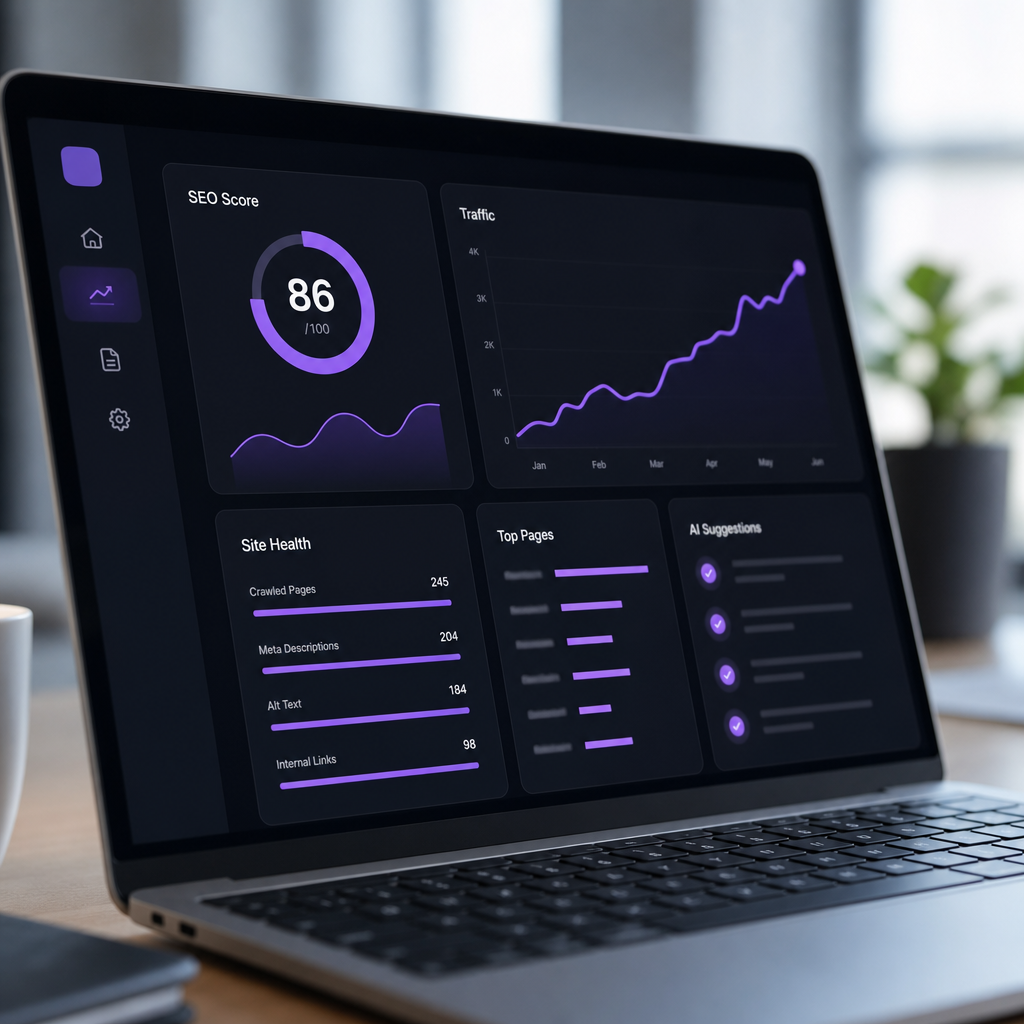
A platform like FrontRank surfaces these metrics directly, removing the need to stitch together Search Console, a rank tracker, a backlink checker, and a manual AI-prompt-testing spreadsheet. For teams that have historically treated AI visibility as unmeasurable, having a single dashboard that quantifies citation frequency is a meaningful operational upgrade.
Common Pitfalls When Automating Webflow SEO
Automation reduces manual labor, but it doesn't eliminate the need for oversight. Teams should watch for:
- Thin or duplicate content — always confirm the platform's AI output is unique per article and passes plagiarism checks.
- Keyword cannibalization — automated publishing at high volume can accidentally target the same keyword twice; clustering logic should prevent this.
- Over-optimization — GEO-focused content should still read naturally; stuffing definitions and lists without narrative flow can hurt both human engagement and model trust.
- Ignoring technical SEO fundamentals — automation handles content and links, but site speed, mobile responsiveness, and structured data still require periodic manual audits, an area covered well by Ahrefs' technical SEO guide.
- Backlink relevance drift — an exchange network should be regularly re-vetted so links stay topically appropriate as your site's focus evolves.
Choosing the Right Platform: A Practical Checklist
When evaluating any SEO automation platform for a Webflow site, run through this checklist:
- Does it offer a native Webflow CMS integration, not just a generic CSV export?
- Does it include built-in keyword research and clustering, or require a separate tool?
- Does it generate SEO and GEO-optimized content, with structure suited to both search engines and AI models?
- Does it provide backlink exchange with relevance filtering, not just bulk link placement?
- Does it include AI visibility auditing across major models (ChatGPT, Claude, Gemini, Perplexity)?
- Can publishing cadence be scheduled and monitored from a single dashboard?
- Is pricing structured for sustainable long-term use, rather than a one-time content dump?
Platforms that check all seven boxes — such as FrontRank — are built specifically to handle the full lifecycle: research, writing, publishing, backlink building, and citation tracking, rather than solving just one piece of the puzzle.
Conclusion
Webflow's design flexibility has made it a favorite for modern marketing teams, but that flexibility comes at the cost of built-in SEO scaling tools. As search behavior increasingly shifts toward AI-generated answers, the sites that win visibility will be the ones publishing consistent, well-structured, backlink-supported content — and tracking whether that content actually gets cited by the AI models users are turning to. An SEO automation platform for Webflow bridges exactly that gap, turning a manual, inconsistent process into a scheduled, measurable system.
FrontRank was built to handle this entire workflow for Webflow, WordPress, Wix, and Shopify sites alike: daily AI-generated, SEO and GEO-optimized articles, automated backlink exchange, and AI visibility auditing, all from one dashboard. For teams that want organic growth and AI search citations without hiring a full content and outreach team, frontrank.com is built to be that infrastructure.
Article written by FrontRank